
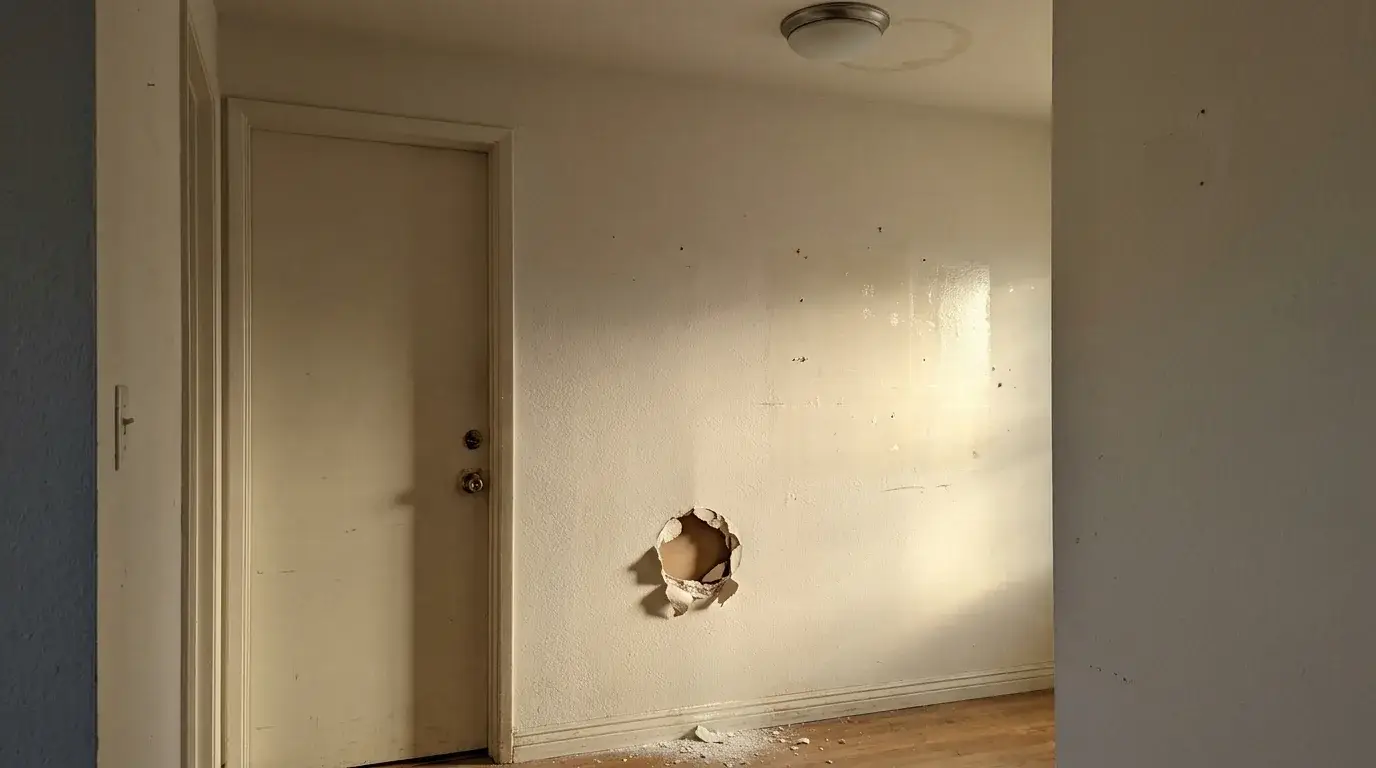
A hole behind a door. A brown ring on the bedroom ceiling. A patch the last guy left that still catches the light from across the room. Drywall damage is rarely dramatic, and it’s almost always annoying, because the wall keeps reminding you it’s there.
This guide is the map. It defines what drywall repair actually covers, helps you figure out which situation you’re in, gives a short overview of every repair type with a pointer to the article that answers it in full, shows one cost table, and names the moments when calling a pro saves you money instead of costing it. Homeowners, renters staring down a move-out deadline, and landlords turning a unit will all find their path below.
What this guide covers:
- What drywall repair means and who needs it
- How to decide which kind of repair you’re facing
- Small holes, dents and nail pops
- Large holes and cut-outs
- Cracks, seams and damage that keeps coming back
- Water damage and ceiling work
- Texture matching, paint touch-up, and what repairs cost
- When to hire a pro and what to ask
What drywall repair covers and who it’s for
Drywall repair restores a damaged section of wall or ceiling so it blends invisibly with the surface around it. That means filling or replacing the damaged area, taping and floating the joint, matching the existing texture, and prepping or touching up paint. It covers small holes, dents, dings, cracks, popped fasteners, failed seams, trade access cut-outs, water-stained ceilings, and texture that never matched in the first place.
According to PTT, drywall construction has become the standard for interior ceilings and walls nationwide.
Who ends up searching for it:
- Homeowners with doorknob holes, TV mount damage, pet scratches, or a ceiling stain after a roof or plumbing leak.
- Renters facing a move-out inspection and a deposit deadline.
- Landlords and property managers turning units between tenants, where a clean wall is the difference between listing today and listing next week.
- Sellers and agents prepping a home for photos, showings or an inspection.
Not every one of these needs a contractor. The next section sorts the jobs you can handle yourself from the ones worth paying for.
How to decide what kind of drywall repair you need
Hire a pro when the damage is bigger than your hand, sits on a ceiling, involves water, keeps coming back, or lands on a textured surface you need to match. Do it yourself when the damage is small, the wall is flat and painted, the room isn’t the first thing guests see, and you have a couple of days for the compound to dry between coats.
Decision guide: choose your path
- Path A, small patch. Nail holes, anchor holes, dents, a single popped screw, nothing wider than about two inches. No moisture, no ceiling, no texture you can’t fake. Go to the small holes section below.
- Path B, medium to large hole. Doorknob strike, fist-sized damage, anything over roughly six inches, or a clean rectangle a plumber or electrician left behind. This needs backing or a replacement piece. Go to the large holes section.
- Path C, cracks that return. A crack you’ve already filled once, a line running diagonally from a door or window corner, a row of nail pops along one stud, bubbling tape. Read the cracks section before you buy more mud.
- Path D, ceiling or water. Stains, sagging, soft drywall, anything overhead. Stop and read the water damage section. This is the category where patching over the problem costs the most later.
- Path E, texture match. Orange peel, knockdown, popcorn, or a hand-applied finish. The repair itself may be easy. Making it disappear is the hard part.
- Path F, deadline. Move-out walkthrough, listing photos, an appraisal, a tenant arriving Friday. When the clock matters more than the savings, hire it out.
Two quick tiebreakers. First, hold a flashlight almost flat against the wall. If the light rakes across the surface and shows ridges, the repair is a finish job, not a fill job. Second, count the spots. One patch is a Saturday. Seven patches spread across three rooms is a trip charge you’d rather pay once.
Small holes, dents, and nail pops
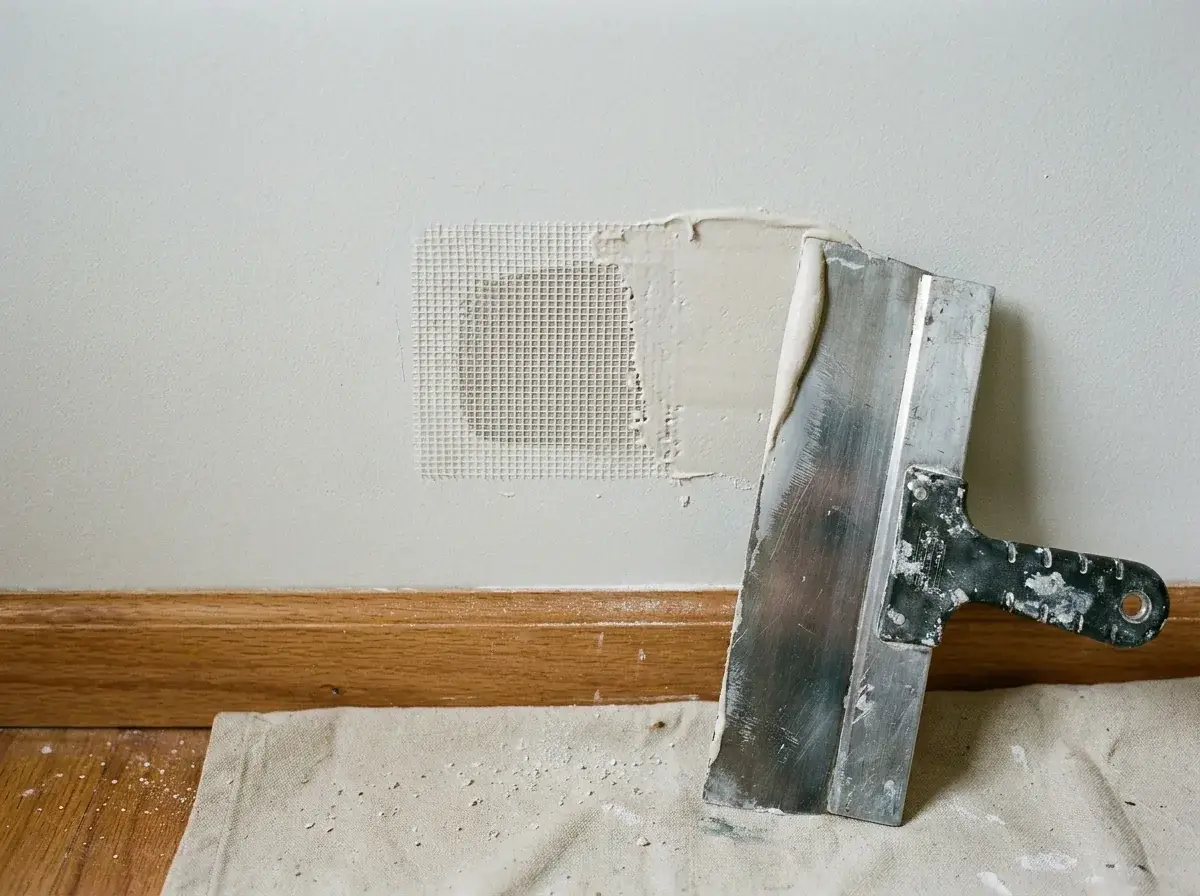
Nail holes, anchor holes, dents and a single popped screw are fill-and-blend work. Nothing structural is missing, so you replace a divot of material, feather the edge wide, sand it light, then prime before paint. For the full how-to, see “How Do I Repair Drywall with Joint Compound? A Beginner’s Step-by-Step Patch Guide.”
A self-adhesive mesh patch covers a hole up to about three inches, lightweight spackle covers the rest, and the real clock is drying time between thin coats. According to This Old House, the estimated time for a basic patching project is 1 hour plus drying time. If you’re working against a move-out walkthrough, “Quick Drywall Repair Step-by-Step: When to Use Spackle, Mesh Patch, or a California Patch” covers the faster methods and their trade-offs.
Large holes and bigger cut-outs
Yes, drywall can be repaired, and a section repair usually beats replacing the whole sheet. Once the opening is wider than your hand there’s nothing behind it to hold compound, so the repair needs support. A wood strip screwed behind the opening, a drywall plug cut to fit, or a new piece landed on framing after the opening is squared out to the center of the nearest studs. Trade access cut-outs from a plumber or electrician land in this group too. For the full how-to, from squaring the opening through the final coat, see “Sheetrock Drywall Repair: What to Expect Step by Step.”
Two things decide how this one looks when it’s done. Backing has to be tight, with screws about every six inches along each strip, or the patch flexes and cracks later. Setting-type compound (the quick-set bags marked 20, 45 or 90 minutes) lets a large patch get its first coats in a single day, at the price of a short working window and harder sanding. Then the finish gets floated well past the patch, often two feet or more in every direction, so the surface stays flat under raking light.
Cracks, seams, and recurring damage
A crack that stays fixed was a surface problem. A crack that comes back, grows, or reappears in the same spot every season is telling you something behind the drywall is moving or wet. For the full how-to on each cause and its matching repair, see “Drywall Damage Repair: What’s Causing It and How to Fix It.”
Warning signs that the repair needs more than compound:
- The same crack returns after one proper repair. One failure can be technique. Two is movement.
- Diagonal cracks running from the upper corners of doors and windows. These follow stress paths in the framing, not the drywall seams.
- A gap at the wall and ceiling corner that opens and closes with the seasons. Seasonal framing movement, common with truss construction.
- A row of nail pops in a straight line. That’s fastener or framing behavior along one member, not random damage.
- Tape bubbling or lifting over a long seam. Usually a bond failure at the original install, sometimes moisture.
- Cracks paired with sticking doors or uneven floors. Look past the wall before you patch it.
Here’s the switch point. If a crack returns after one repair, or you see diagonal door and window cracks, a wall-ceiling gap that opens and closes with the seasons, nail pops in a line, or bubbling tape, stop patching and start diagnosing with “Drywall Damage Repair: What’s Causing It and How to Fix It.” Some joints get re-taped with paper tape set in setting compound, some need the fastener pattern corrected first, and some need the cause handled before anyone touches the wall. The prep errors that guarantee a second repair are listed in “5 Plaster and Drywall Repair Mistakes That Cost You Money.”
Water-damaged drywall and ceiling repairs
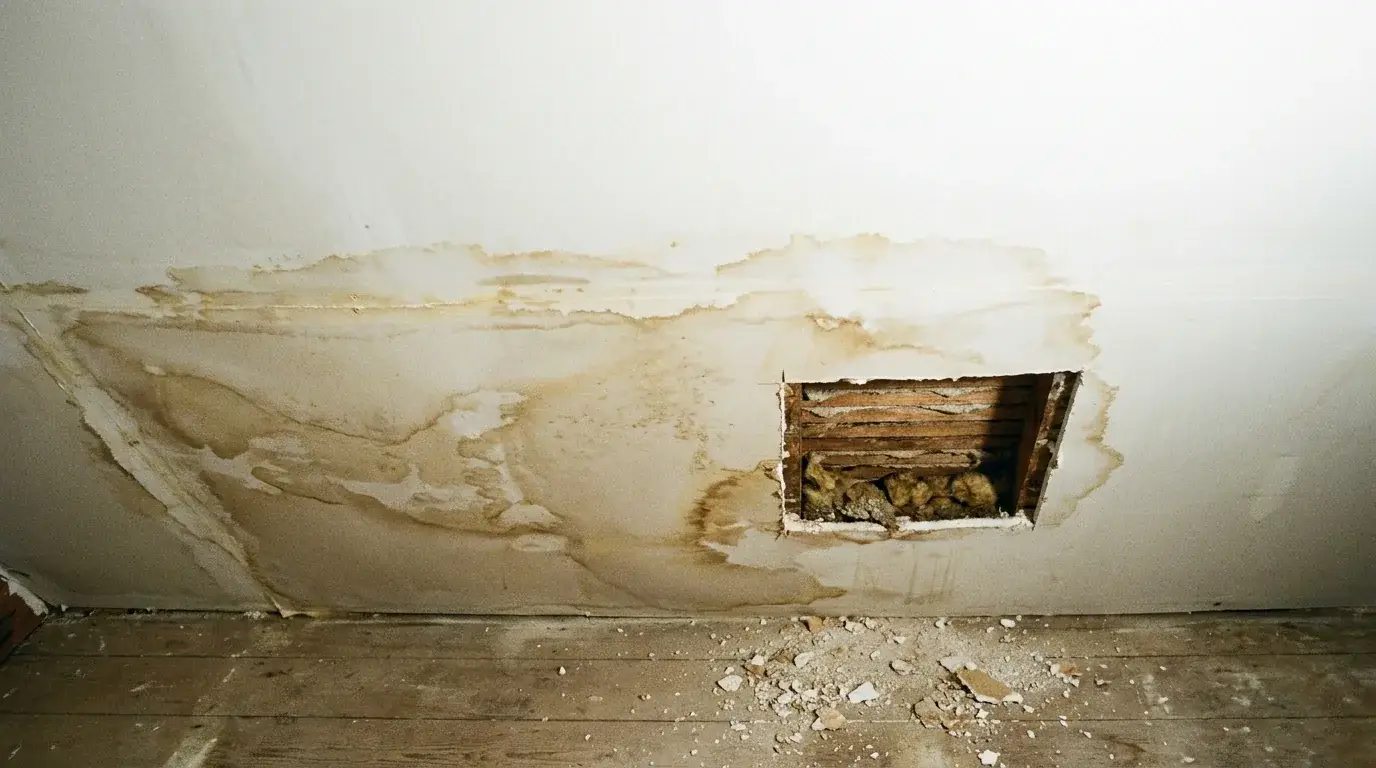
Water-damaged drywall needs replacement rather than patching when the panel is soft, sagging, crumbling under light pressure, or still reading wet after the leak is fixed. A stain alone can sometimes be sealed and refinished. A ceiling panel holding water weight cannot, and it’s the one category where guessing is genuinely unsafe. For the full how-to on the tests and thresholds, see “Drywall Damage Repair: What’s Causing It and How to Fix It.”
Three things change the decision. Overhead work means gravity fights every coat and falling material is a real risk. Moisture spreads sideways behind the surface, so the visible stain is usually smaller than the damage. And the source has to be dead before the repair starts, because a patched ceiling over an active leak just restarts the clock.
Order of operations matters here. Fix the leak, dry the cavity completely, then repair. Precision Patch Pros handles the drywall side of that sequence and doesn’t perform water extraction, emergency dry-out, leak detection or mold remediation, so those steps come first, from the appropriate trade. In one recent job, a mobile home roof leak had left ceiling panels hanging down. Once the attic was dried out, the damaged panels were cut away and replaced with new drywall, taped, floated and textured, with custom molding to finish the transition. If you want yours looked at, send us 2-3 pictures and your zip code and we’ll get back to you within 10 minutes.
Texture matching and paint touch-up
A textured wall raises the difficulty of every repair, because orange peel, knockdown and popcorn have to be sprayed or hand-blended to match the pattern, density and age of the surface around them. For the full how-to on matching each texture type, see “How Do I Repair Drywall with Joint Compound? A Beginner’s Step-by-Step Patch Guide,” and for how texture and paint fit into the whole job, see “Sheetrock Drywall Repair: What to Expect Step by Step.”
Here’s why those textures still flash even when the patch is dead flat. Sprayed texture lands in a slightly different droplet size and density than the original crew left, so the edge of the repair reads in raking light, and fresh compound drinks paint differently than an aged wall, so the spot dries brighter or duller. Generous blending is what hides it. Feather each coat 8 to 12 inches past the repair, plan on 2 to 3 coats with a light sanding between them, then prime the repair and carry the paint out into the surrounding wall instead of stopping at the patch edge.
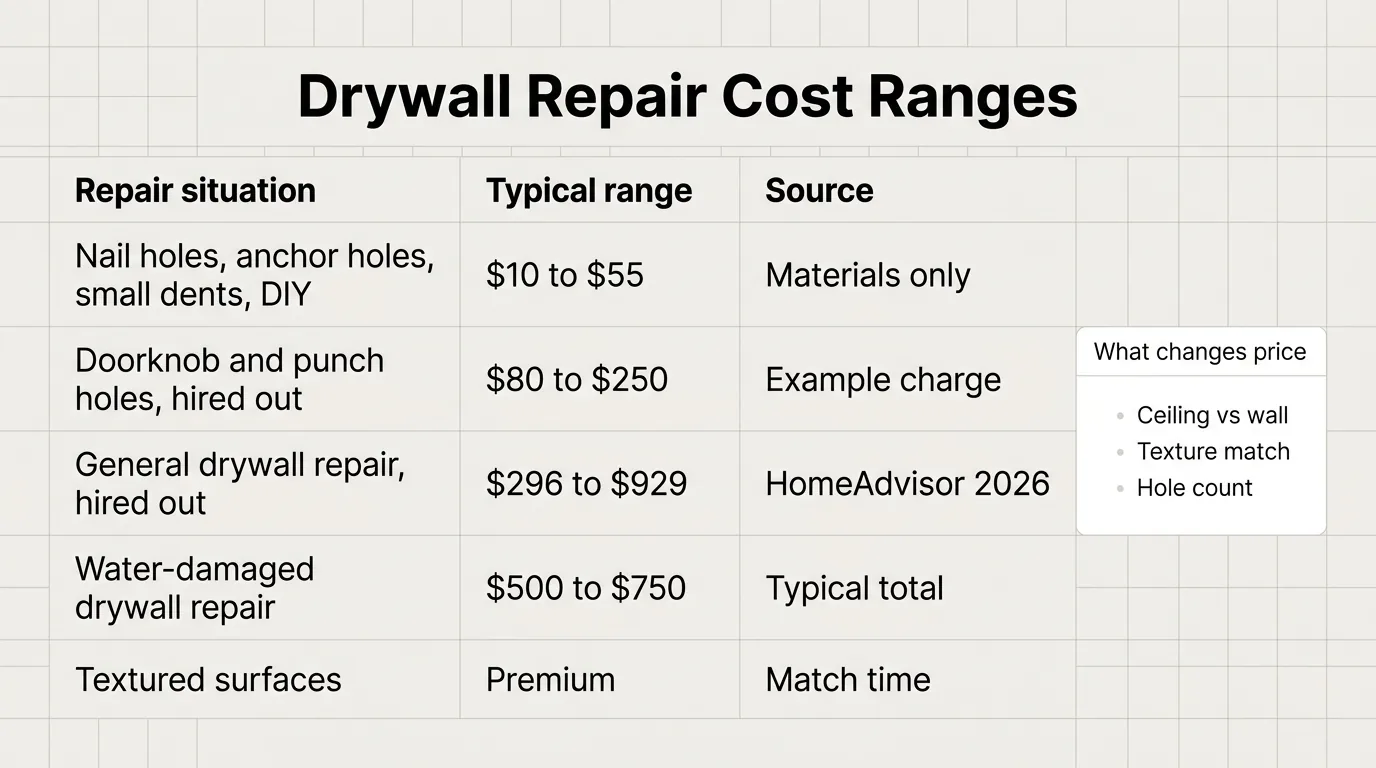
Here’s the headline pricing picture, and it’s the only pricing in this guide. According to HomeAdvisor, drywall repair in 2026 normally runs between $296 and $929. Materials for a small hole you fix yourself run far less, usually $10 to $55.
| Repair situation | Typical range | Where the number comes from |
|---|---|---|
| Nail holes, anchor holes, small dents, DIY | $10 to $55 in materials | Headline range, more spots cost more |
| Doorknob and punch holes, hired out | $80 to $250 | Our own example charge, varies with hole count and texture |
| General drywall repair, hired out | $296 to $929 | National headline range, patch size, ceiling versus wall |
| Water-damaged drywall repair | $500 to $750 | Our typical total, panel replacement and ceiling work included |
| Textured surfaces | Premium on any row above | Hand-blending time, spray trials, match difficulty |
Two practical notes. A minimum service charge usually applies to very small jobs, so bundling several patches into one visit costs less per hole than three separate calls. Financing is available on larger jobs, with no home equity required.
When to hire a pro for drywall repair
Some drywall damage is a Saturday. The rest is a finish job, where the work is less about closing the hole and more about making it disappear under the light. That second group is where a specialist earns the call, because the patch, the texture match and the paint touch-up happen as one job instead of three separate trades.
Call a pro when:
- The hole is larger than your hand or needs backing.
- The damage is on a ceiling, especially after a leak.
- You see staining, sagging or soft drywall.
- The same crack or seam has failed more than once.
- The surface is orange peel, knockdown, popcorn or any hand-applied texture.
- You have several patches across multiple rooms.
- A move-out walkthrough, listing date, appraisal or tenant arrival is on the calendar.
- The wall is high-gloss, deeply colored, or lit by a window that rakes across it.
What to ask before hiring:
- Are you licensed and insured, and what’s the license number? Precision Patch Pros is licensed and insured under CSLB License #830875 and has served Southern California since 2020.
- Do you match texture and touch up paint, or do I need a painter afterward?
- Can this be done in one visit, patch, texture match and paint touch-up included?
- What’s the workmanship guarantee? Ours is 5 years.
- How do you protect floors and furniture, and who cleans up?
- Is the scope written down before work starts?
If you’re searching for drywall repair near me across Bakersfield, the Antelope Valley, the High Desert, Santa Clarita or the San Fernando Valley, skip the scheduling and start with photos. Send us 2-3 pictures and your zip code for a quote within 10 minutes, and get the wall back to looking like nothing ever happened.
Frequently Asked Questions
What tools and materials are needed for small drywall patches?
Lightweight spackle or all-purpose compound, a mesh patch, a fine sanding sponge, primer and matching paint cover almost every small repair. The one item that decides how it looks is knife width. A 6-inch knife fills, but you need a 10 or 12 inch knife to feather the edge far enough to hide it. Product picks and the full kit are laid out in “Quick Drywall Repair Step-by-Step: When to Use Spackle, Mesh Patch, or a California Patch.”
What counts as a large drywall repair?
Once the opening is wider than about six inches, there’s no gypsum left to support compound, so the repair needs backing or a replacement piece cut to the framing. Anything that spans a stud bay, runs along a seam for several feet, or involves more than one panel falls into the large category. These jobs also need wider floating, often two feet or more past the patch, to stay flat under raking light.
Does homeowners insurance cover drywall repair?
Coverage usually depends on the cause, not the drywall. Sudden and accidental events such as a burst pipe or storm damage are often covered, while long-term leaks, gradual wear and general maintenance typically are not. Document the damage with photos before anyone touches it, and ask your carrier whether the repair falls under your deductible before scheduling work.
Do I need a licensed contractor for drywall repair in California?
For anything beyond a very small job, yes. California requires a licensed contractor for some home improvement work when the labor and materials total is around $500 or more. Always verify the license number is active before work begins. Precision Patch Pros holds CSLB License #830875.
How do I choose a drywall repair company near me?
Look for three things. A verifiable license, proof of insurance, and photos of texture-matched repairs rather than bare patches. Ask whether patching, texture and paint touch-up happen in one visit or across separate trades, since split scopes are where matching problems start. A written guarantee on workmanship tells you how confident the company is that the repair will hold.
Should I fix drywall damage before selling or listing my home?
Yes, for anything visible in a main living area or on a ceiling. Unrepaired holes and stained ceilings show up in listing photos and get written into inspection notes, which invites price negotiation far larger than the repair itself. Ceiling stains in particular read as an active leak to buyers, even when the leak was fixed years ago.
Who handles drywall damage at move-out, the tenant or the landlord?
Normal wear such as small nail holes from hanging pictures generally falls to the landlord, while doorknob holes, anchor damage, TV mount holes and pet damage are usually charged to the tenant. Most disputes come down to photos and timing, so document the walls before you hand back keys. Getting the patches, texture and paint done in one visit before the walkthrough is almost always cheaper than a deposit deduction.
Is drywall repair worth doing before repainting a room?
Always repair first. Fresh paint magnifies dents, ridges and old failed patches instead of hiding them, and a uniform sheen makes every imperfection catch the light. Patch, texture match, prime the repairs, then paint the full wall so the finish stays consistent corner to corner.
Is ceiling drywall repair harder than wall repair?
Yes, and the decision rule is short. If the repair is overhead and bigger than a light fixture canopy, hire it out. Compound sags on a ceiling, so coats go on thinner and dry longer, and popcorn or knockdown overhead is the hardest texture to match. “Sheetrock Drywall Repair: What to Expect Step by Step” walks through how a ceiling job runs visit by visit.