
The Short Version: How Long Sheetrock Drywall Repair Usually Takes
Most sheetrock drywall repairs take somewhere between one visit and five days. The difference comes down to what the mud is doing, not how hard anyone is working. A small hole patched with setting-type compound, textured, and touched up with paint can be finished in a single visit of two to four hours. A standard repair with premixed compound usually runs two to five days, because each coat needs its own drying cycle before the next one goes on. The hands-on labor might only be three or four hours total. The waiting is what stretches the calendar.
Small patches commonly land at two to three days. Larger patches at three to four days. Full-room finish work at four to five days when standard drying compounds are used. Water-damaged drywall is its own timeline. That clock starts with drying, not patching.
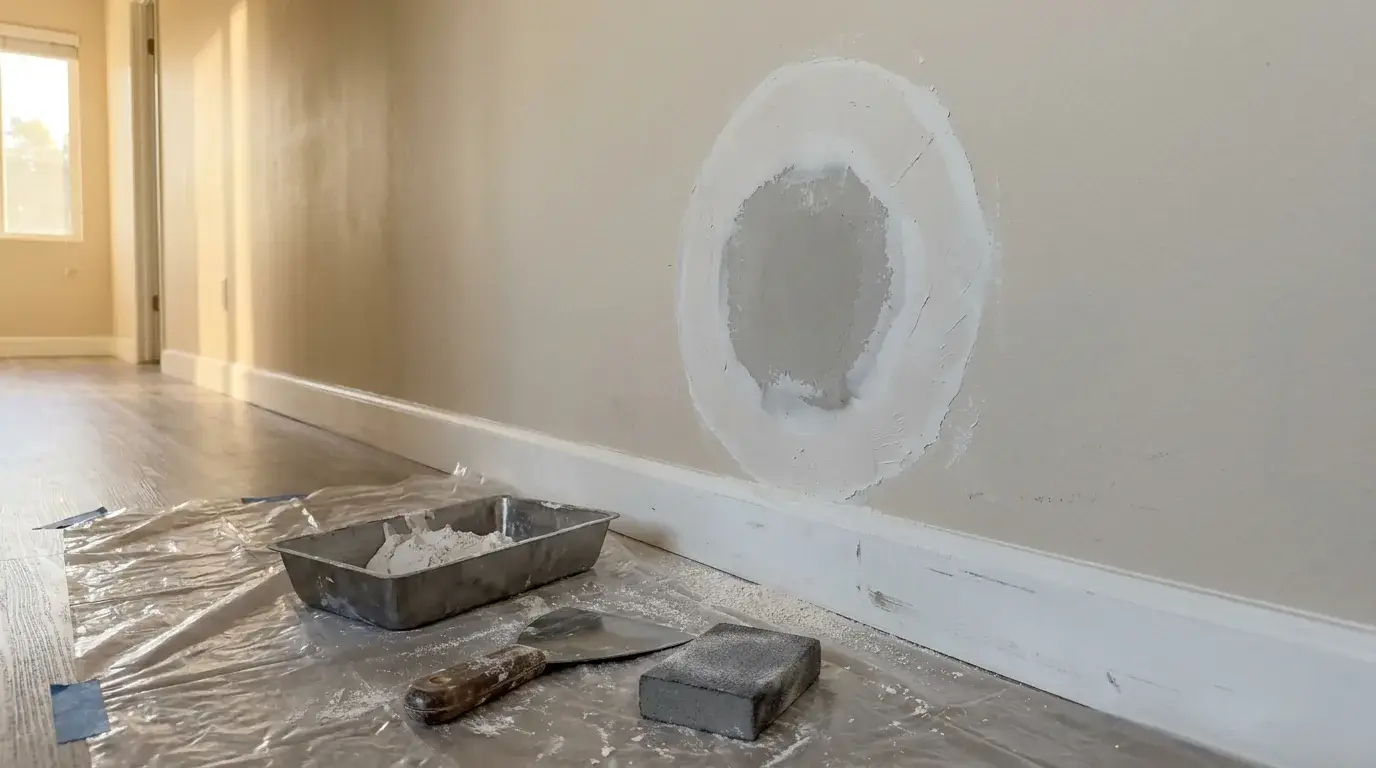
Timeline at a Glance
Here is the whole job, phase by phase, with the time each part takes and what you need to handle.
| Phase | What happens | How long it takes | What you do |
|---|---|---|---|
| 1. Assess and plan | Damage is measured, cause checked, repair method and coat count decided | 10 to 30 minutes, or 10 minutes by photo | Send 2 to 3 pictures, point out every spot you want fixed |
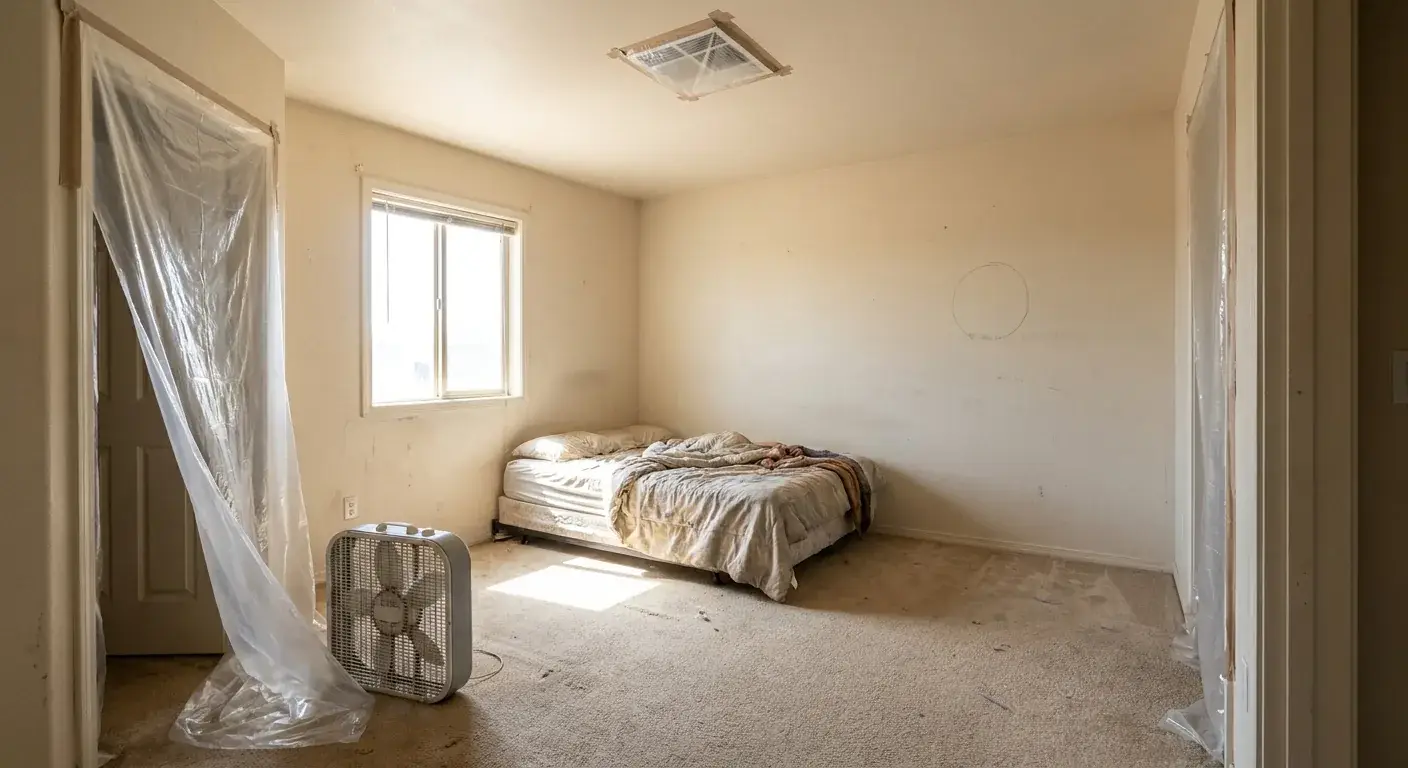
| 2. Prep the room | Furniture moved, floors and fixtures covered, dust control set up | 15 to 45 minutes | Clear a 4 to 6 foot working radius, unlock access, leave lights on |
| 3. Cut back and patch | Loose material trimmed, backing added, new board or patch set, tape or mesh applied | 20 minutes to 2 hours per opening | Stay out of the work zone, keep pets in another room |
| 4. Compound coats | 2 to 4 coats, each feathered wider than the last | 20 to 90 minutes set time for hot mud; about 24 hours per coat for premixed | Keep airflow steady, do not touch or test the patch |
| 5. Sand, texture, paint-ready | Final sanding, texture match, primer, touch-up paint | 45 minutes to 3 hours | Keep the room ventilated, plan on light dust cleanup |
| After | Cure, paint sheen settles, final inspection | 24 hours to a few days | Check the patch in daylight and side lighting |
Phase 1: Assess the Damage and Set the Plan
Drywall repair means restoring the damaged surface back to a flat, textured, paintable wall or ceiling without replacing the whole sheet. The first look decides everything downstream. How many coats. How many drying cycles. Whether this is a one-visit job or a multi-day one. A pro reads the damage in four buckets.
- Dents, nail pops, and holes under 2 inches. One or two coats. Often same-visit work.
- Cracks and failing seams. The old tape gets cut out and re-bedded, so plan on an extra coat and extra feathering width.
- Holes from 2 to 12 inches. Backing or a California patch goes in first. Two to three coats.
- Openings over 12 inches, or ceiling damage. New board, screws into framing, tape, then three to four coats.
The assessment also catches the things that change the whole plan. A stain that spreads. A soft spot. A ceiling that sags. Any of these mean moisture is still in play. At Precision Patch Pros, a moisture meter confirms the area is dry and an antimicrobial solution is applied before new drywall goes in. You can skip this phase in person entirely. As NIOSH notes, drywall sanders were exposed to as much as 10 times the OSHA permissible exposure limit of 15 mg/m3 for total dust.
Phase 2: Prep the Room and the Repair Area
Before a drywall contractor arrives, clear a working radius of about four to six feet around every repair spot and pull anything fragile out of the room. That single step usually saves 20 to 30 minutes on arrival, and on a one-visit job those minutes matter.
What to have ready:
- Furniture moved or grouped in the center, away from the walls being patched.
- Access to the damage. Take down the TV mount, the shelf, or the art. Unlock the gate and the room.
- Working power and light. Sanders and lights need outlets, and good light is how a finisher sees a low spot.
- Pets and kids somewhere else for the duration. Wet compound and curious hands do not mix.
- A ventilation plan. Open a window or leave the fan running. Airflow is a drying accelerator.
Where this phase runs long: blocked access, a garage full of boxes in front of the wall, or an unprotected room that needs full plastic containment. Dust is the reason for the plastic. If you would rather skip the learning curve, you can send photos and get a repair plan back in about ten minutes.
Phase 3: Cut Back, Patch, and Reinforce the Opening
Repairing damaged sheetrock starts with removing what cannot be saved. Crumbling edges, torn paper facing, and bubbled tape all get cut back to solid material. Compound applied over loose paper will telegraph and crack within a year. Then the opening gets support.
The work, in order:
- Square up the hole. A clean rectangle is easier to patch than a ragged one.
- Add backing. For openings that do not land on a stud, wood strips or a furring piece get screwed inside the cavity to give the new piece something to bite.
- Set the patch. A cut piece of sheetrock, matched to the existing thickness, or a California patch for mid-size holes where the paper flange does the bridging.
- Tape the perimeter. Mesh or paper, depending on the joint and the finisher’s preference.
Time runs 20 minutes for a doorknob hole to two hours for a large opening with framing to work around. Ceilings take longer. Gravity fights every step, the patch has to be held while it is fastened, and any misalignment shows under the ceiling light that grazes across it. That is why a small ceiling repair can take as long as a wall repair twice its size.
Can you do this yourself? For a nail hole or a small dent, yes. According to Angi, premixed joint compound dries in 24 hours per coat, and with 2 to 4 coats on a typical patch, that is where the two-to-five-day range comes from.
Phase 4: Apply Compound and Wait Between Coats
This is where the calendar gets decided. Send 2 to 3 pictures and get your quote within 10 minutes, and you will know whether your timeline is realistic before you commit to anything. Setting-type compound, called hot mud, works differently. It hardens through a chemical reaction. Setting-type joint compound starts setting within 20 to 45 minutes. Hot mud is sold in 5, 20, 40, 45, and 90 minute versions. That is how a pro compresses three coats into one afternoon.
Pro-tip: set time is not the same as dry time
The number on the hot mud bag tells you when the compound stops being workable. It does not tell you when the water has left the mix. A 45-minute mud can be hard to the touch in an hour and still be holding moisture two or three hours later, especially in a thick fill. Two simple checks: a set-but-wet patch looks darker than the surrounding compound and feels cool to the back of your hand. Wait until the color is uniform and the chill is gone. In a cool, humid room a heavy fill of hot mud can take a full day or more, no matter what the label says.
The other timeline lever is coat thickness. A thin skim coat can be dry in 4 to 6 hours in ideal conditions. A thick fill coat needs 8 to 12 hours. A deep fill over a large hole can push the wait to 24 to 48 hours. This is why experienced finishers build in three thin coats instead of one fat one. Three thin coats dry faster in total than one thick one, and they shrink less.
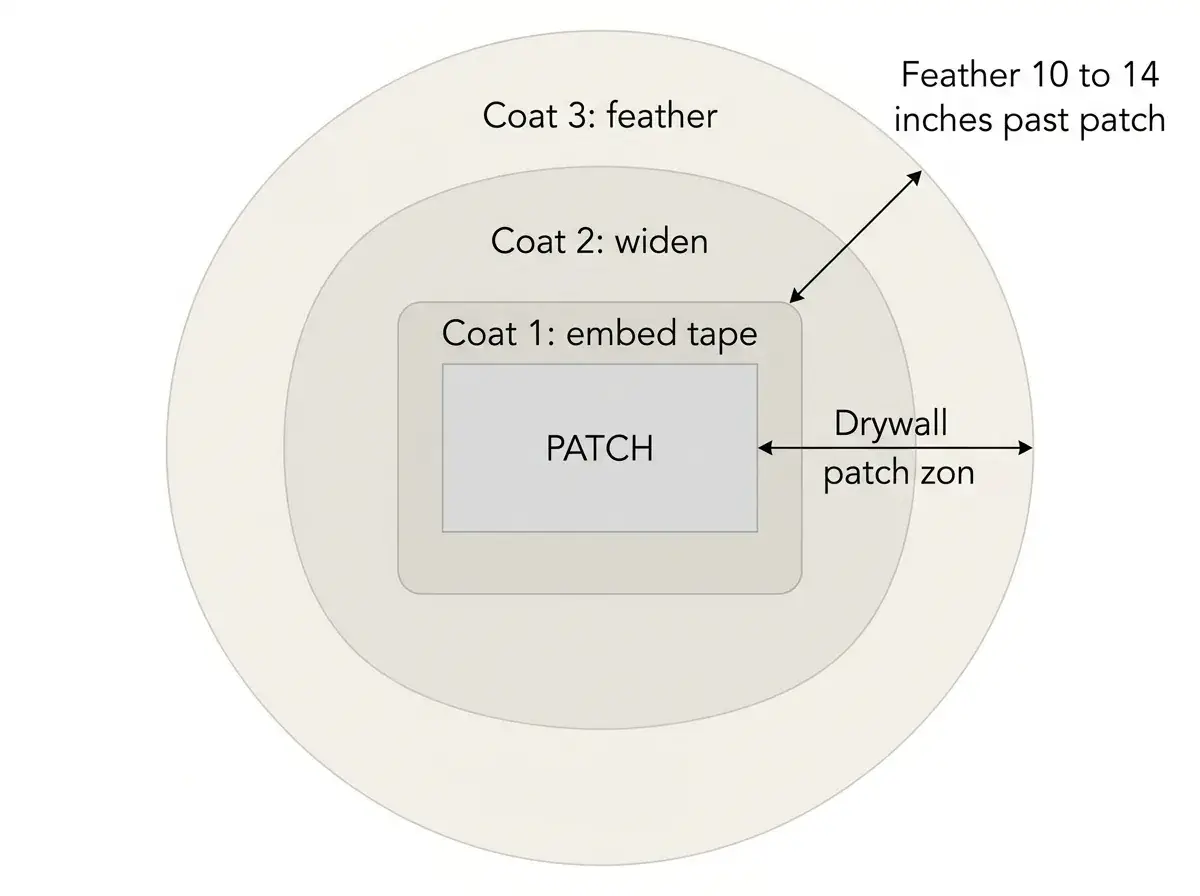
Each coat goes on wider than the last. Coat one fills and embeds the tape. Coat two covers the tape and adds width. Coat three feathers the edges out 10 to 14 inches past the patch so no ridge catches the light.
Phase 5: Sand, Touch Up, and Make It Paint-Ready
Sanding starts only when the final coat is fully dry, not when the surface looks matte. That distinction is the single most common cause of rework on a drywall repair. Sand a coat that is still wet underneath and the paper backing of the sandpaper tears material out of the patch, leaving gouges that need another coat and another full drying cycle.
Sanding itself is quick, usually 10 to 30 minutes for a standard patch. Then comes the part that decides whether the repair disappears: texture matching. Orange peel, knockdown, smooth, and popcorn each spray and knock down differently. The match has to be dialed in on a test board before it touches the wall. Budget 20 minutes to an hour for texture on a typical patch, plus the texture’s own dry time before primer.
Can drywall repair be painted the same day? Yes, when setting-type compound is used, the coats are thin, and the texture is light. That is how most of our jobs finish in one visit, patch, texture match, and paint touch-up together. With premixed compound and a heavy fill, the honest answer is no. Primer over damp compound flashes, and the patch shows through the paint as a dull halo that only gets worse in side light.
Paint-ready means three things are true: the compound is hard and uniform in color, the sanded surface is flat under a raking light, and the primer has gone on and dried. Touch-dry means only that the top skin has firmed up.
What Changes the Timeline Most
Two jobs with identical holes can finish a day apart. These are the variables that decide which one you get.
- Patch size and depth. A 2 inch doorknob hole is two coats. A 16 inch ceiling opening is four coats plus texture, which adds one to two days on premixed mud.
- Coat thickness. Overbuilt patches are the hidden delay. A fill thick enough to need 24 to 48 hours to dry also shrinks, which usually adds one more coat.
- Temperature. A coat that dries in 4 to 6 hours at 70°F can need 12 to 18 hours at 55°F. Cold garages and unheated rooms are where schedules slip.
- Humidity. Damp conditions can add roughly 50% to normal drying times. The dry air across Kern County and the high desert is an advantage here. Coastal humidity and winter rain are not.
- Ventilation. A closed room with no airflow can double the wait. A box fan aimed across, not directly at, the patch is the cheapest schedule saver there is.
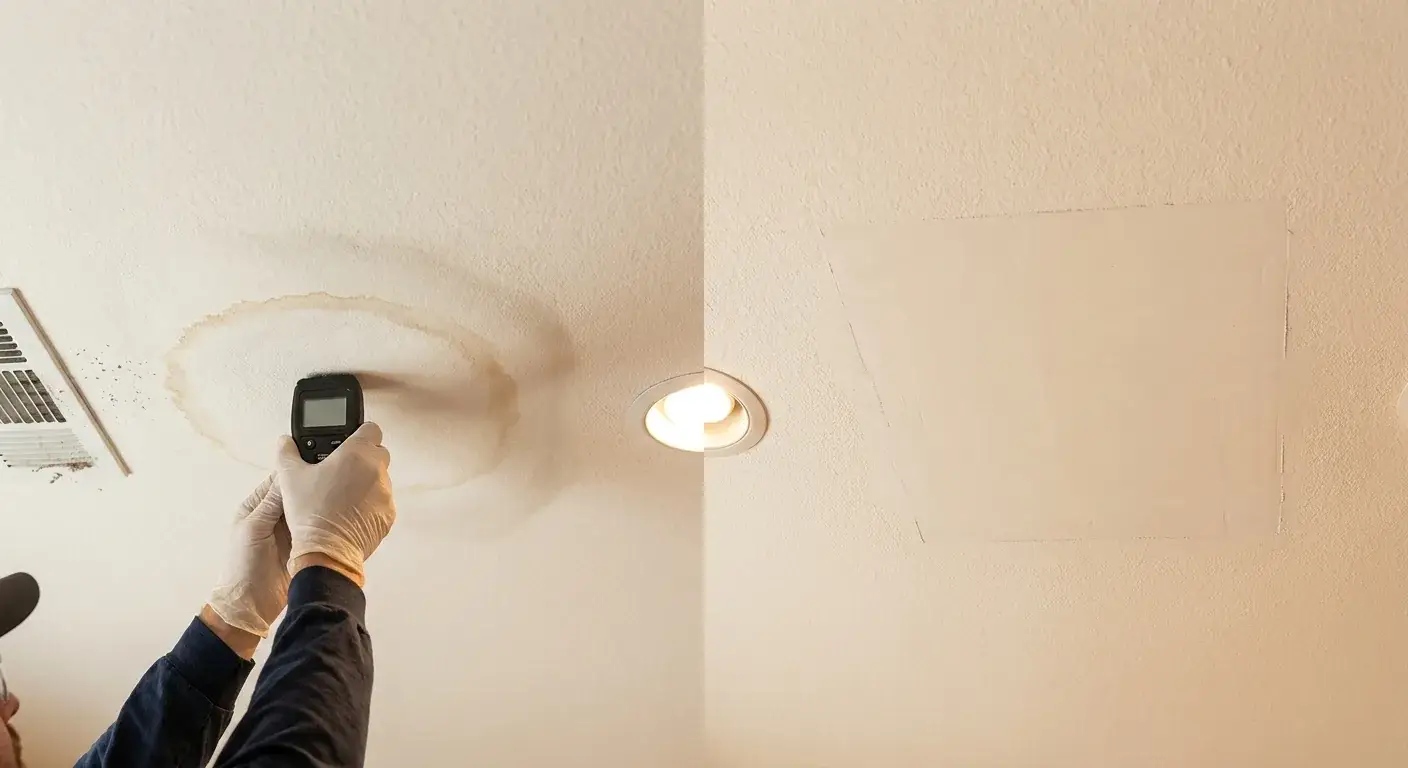
- Water saturation. This is the big one. Fully saturated drywall typically takes 3 to 5 days to dry under good conditions before any repair begins, and the moisture meter decides, not the calendar.
- Texture type. Smooth walls are actually the slowest to finish, because there is no texture to hide a flaw. Knockdown and orange peel forgive more and go faster.
- Number of separate locations. Ten small patches in six rooms take longer than one large patch, because every location needs its own prep, its own protection, and its own cleanup.
One recent job shows the range. A dated coffered dining room ceiling needed the section reframed, new drywall hung, taped and floated, LED recessed lighting added, then skim-coated and retextured for a uniform finish. That is a multi-visit project by definition. A doorknob hole in a hallway is not.
If a deadline is driving this, say so up front. Move-out inspections, listing photos, and lease turnovers all have hard dates, and the repair method gets chosen around them.
Frequently Asked Questions
How long does sheetrock repair take for a small hole?
A hole under 2 inches takes 20 to 40 minutes of actual work, spread across two coats. With setting-type compound, both coats plus sanding and paint can happen in one visit of about two hours. With premixed compound, plan on two days because the first coat needs 24 hours before the second goes on.
How many coats does a drywall patch usually need?
Two to four. Small holes and dents take two, most patches take three, and large openings or failing seams take four. Each coat gets feathered wider than the last so the edge of the repair blends into the flat wall instead of stopping at a visible line.
What is the most effective way to repair drywall?
Match the method to the damage. Under 2 inches, use compound over a mesh patch. From 2 to 8 inches, a California patch with a paper flange is the fastest reliable fix. Over 8 inches, cut a square opening, add backing, and set a new piece of sheetrock. Our companion piece “Quick Drywall Repair Step-by-Step: When to Use Spackle, Mesh Patch, or a California Patch” walks through each one.
Do drywall repair kits work?
For small holes in smooth or lightly textured walls, yes. Self-adhesive mesh patch kits hold fine when the patch stays under about 4 inches and you build three thin coats over it. They fail when the hole is bigger than the patch was designed for, or when the surrounding drywall edge is soft and crumbling.
Does humidity make drywall mud dry slower?
Yes, and significantly. Damp conditions can add around 50% to normal drying times, and cool plus humid together is worse than either alone. Running a fan and a dehumidifier in the room is the fastest fix, and it also protects against the surface skinning over while moisture stays trapped below.
How long does a water-damaged drywall repair take?
Longer than the patch itself suggests. Fully saturated drywall typically needs 3 to 5 days to dry under good conditions before repair can start, and the area should be verified dry with a moisture meter first. Note that water extraction and emergency dry-out are separate services we do not provide, so that drying step happens before the repair phase begins.
How much dust will sanding create in a lived-in home?
More than most people expect from hand sanding, which is why containment matters. OSHA’s permissible exposure limit for respirable dust is 5 mg/m3, and open hand sanding blows past it easily. Vacuum-assisted sanding, taped doorways, and covered vents keep the mess to the work zone and cut cleanup to a few minutes.
Can a handyman fix drywall?
Many can handle a nail hole. The trouble usually starts at texture matching and paint blending, where a patch that is flat and solid still reads as a bright spot on the wall. A specialist handles patch, texture match, and paint touch-up as one finish job, which is why that work is worth booking with someone who does it daily.