
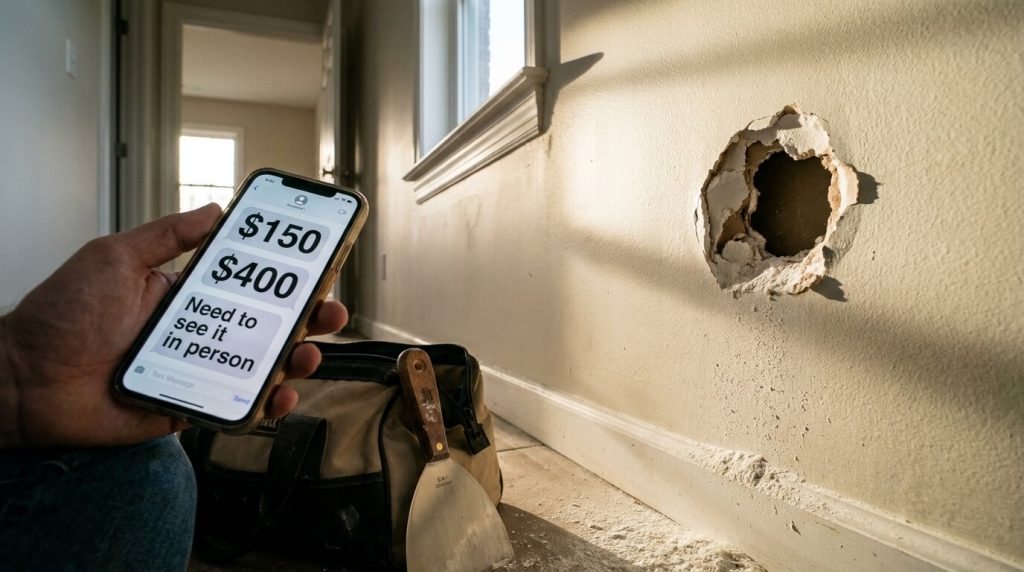
You text three contractors the same photo of a fist-sized hole in your hallway. One quotes $150. Another says $400. The third tells you they can’t give a firm number without seeing it in person. You’re left wondering if drywall repair costs are made up on the spot, or if there’s actually a method to the madness.
Drywall repair pricing isn’t arbitrary, but it’s also not as simple as counting square inches of damage. The wide swings in quotes you’re seeing reflect differences in what the job includes, how contractors structure their pricing, and what level of finish quality you’re paying for. A cheap patch that shows up in certain lighting isn’t a deal. It’s deferred embarrassment. This guide will help you understand fair pricing for invisible results, not just the lowest number.
Why Drywall Repair Pricing Varies So Widely
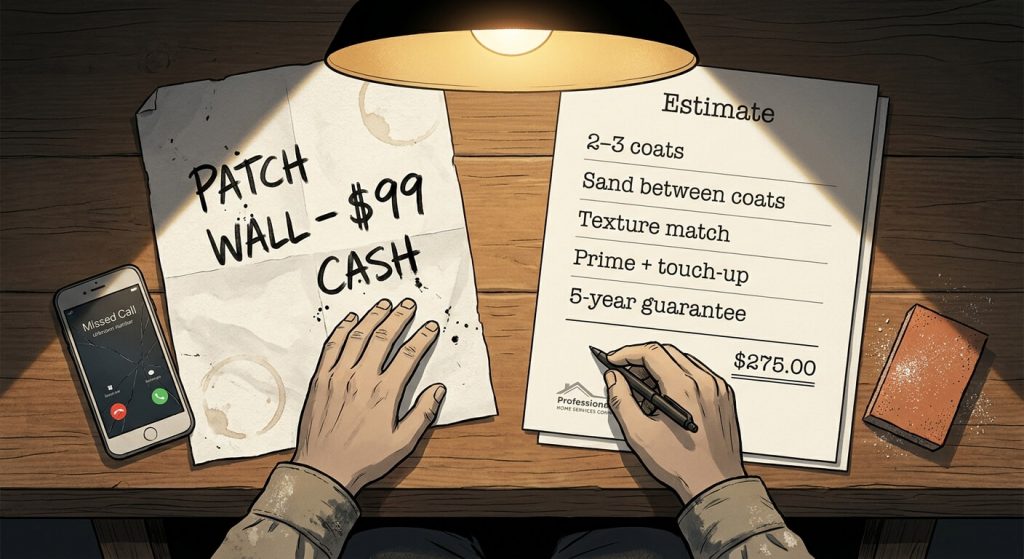
If you’ve gotten quotes ranging from $150 to $800 for what looks like the same repair, you’re not alone. The confusion stems from a simple fact: contractors are pricing different products under the same label. One crew treats a patch as “fill the hole and get out.” Another treats it as finish carpentry for walls, matching texture, feathering edges until they disappear, and touching up paint to blend perfectly.
Material cost for a small patch is as low as $20. The rest is labor, skill, and whether the contractor cares if you can see the repair when light hits the wall at an angle. Cheap and invisible don’t coexist. When a quote seems too good to be true, it usually means the repair will be obvious once it dries, and you’ll be calling someone else to fix it properly. The goal of this guide is to help you recognize fair value, not train you to chase the lowest bid.
The Three Pricing Models: How Contractors Quote
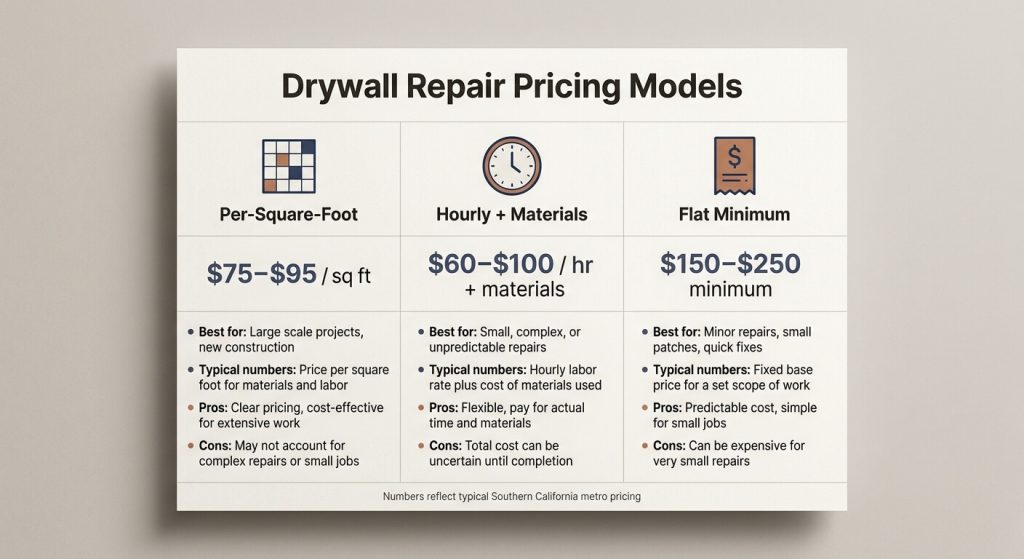
Drywall contractors don’t all speak the same financial language. Some charge by the hour. Others quote a flat minimum. The best use per-square-foot pricing because it aligns your interest (their profit and quality of work) into one number. Understanding these models reveals what kind of shop you’re dealing with and what to expect when the invoice arrives.
Per-Square-Foot Pricing
Expect to pay $75 to $95 per square foot for quality repair in Southern California markets. This model works because it rewards contractors who finish fast and precisely. They profit from efficiency and skill, not from dragging out the clock or skimping on feathering and texture blending.
When a contractor quotes per square foot, they’re confident enough in their process to name a fixed price upfront. It also means they’ve done this repair hundreds of times and know exactly how long proper texture matching and blending will take. You get predictable cost. They get predictable margin.
Hourly Labor + Materials
Some contractors charge $60 to $100 per hour, plus materials. This model creates uncertainty for you and removes the contractor’s incentive to finish quickly. A five-hour job at $80 per hour becomes $400 before materials, and you won’t know the final cost until the work is done.
Hourly pricing makes sense for complex jobs where scope isn’t clear upfront, but for routine patch work it usually means the contractor hasn’t systematized their process. That’s a red flag.
Flat Minimum Charge
Most reputable shops have a minimum service charge (typically $150 to $250) to cover overhead, travel time, and setup. This is standard practice, not a penalty. Small jobs don’t subsidize larger ones. A contractor who drives 40 minutes to patch a doorknob hole still needs to cover fuel, insurance, and scheduling overhead.
If a shop waives the minimum, ask what corners they’re cutting to make it pencil.
Comparison Table: Repair Pricing by Damage Class
| Damage Type | Typical Size | Labor Cost | Materials | Texture Complexity | Total Price Range |
|---|---|---|---|---|---|
| Small hole (nail, screw) | 1–4 sq in | $100–$150 | $10–$20 | Low | $125–$175 |
| Medium hole (doorknob, fist) | 6–24 sq in | $150–$250 | $15–$30 | Medium | $200–$300 |
| Large hole or section | 1–4 sq ft | $300–$450 | $30–$75 | Medium–High | $350–$550 |
| Ceiling patch (any size) | Varies | Add 20–30% | Same | High | Add $50–$150 |
| Water-damaged drywall | 2–8 sq ft | $400–$600 | $50–$100 | High (stain blocking) | $500–$750 |
| Textured wall matching | Any repair | Add 15–25% | Add $10–$25 | High | Add $50–$100 |
This table captures typical ranges for 2026 in metro Southern California. Rural areas or lower cost-of-living regions may see prices 20 to 30% lower, but the labor-to-materials ratio stays similar.
What’s Actually Inside Your Repair Cost?
Let’s break down a common scenario: a medium-sized hole caused by a doorknob hitting the wall. The contractor quotes $275. Here’s where that money goes.
Materials: $20 to $30. You’re paying for a drywall patch cut to size, joint compound, sanding supplies, primer, and touch-up paint. Even on a larger job, materials rarely exceed 15% of the total invoice.
Labor: $200 to $250. This is where the value lives. A skilled finisher will feather the compound out 8 to 12 inches beyond the patch so the transition is invisible. They’ll match your wall texture (whether it’s orange peel, knockdown, or smooth). They’ll apply two to three coats, sanding between each, then prime and touch up paint to blend with the existing finish.
Overhead and travel: $25 to $50. Vehicle cost, insurance, scheduling software, and the time spent driving to your home all have to be covered. That’s why scheduling multiple small repairs in one visit often saves you money per repair.
Labor: The Invisible Skill
Texture matching and edge feathering are not beginner skills. A $300 professional repair beats a $100 DIY botch that requires full rework because the patch is visible in morning light. Contractors who charge appropriately for labor are confident their work disappears. Contractors who discount labor are betting you won’t notice (or that you won’t call them back when you do).
The best finishers don’t apologize for high labor rates. They guarantee their work for years because they know it won’t fail.
Materials: Joints, Compound, Paint, and Primer
For a typical small-to-medium repair, expect about $15 to $35 in materials: pre-mixed joint compound, a piece of drywall or patch kit, sanding mesh, stain-blocking primer, and a small amount of matched paint. Materials are the cheapest part of any drywall job. If a contractor is emphasizing low material cost as a selling point, they’re distracting you from the labor quality.
High-end jobs may use specialty textures, anti-mold primers, or flexible patch systems (adding $10 to $25), but even then materials stay a small fraction of the invoice.
Travel and Overhead
Contractors carry general liability insurance, workers’ comp if they employ helpers, vehicle maintenance, fuel, and business software costs. These aren’t optional. When you see a $150 minimum charge for a small patch, you’re covering the contractor’s cost to show up. This is normal and fair. Truly local shops aren’t always cheaper. They’re nearby because they operate efficiently and serve enough customers to sustain routes.
Premium Factors That Add Cost (and Why They’re Worth It)
Not all drywall repairs are created equal. These factors increase cost, but they also ensure the repair lasts and looks perfect:
- Texture matching (popcorn, orange peel, knockdown): Adds 15 to 25% to labor cost. Smooth walls are the easiest to patch invisibly. Textured finishes require spray equipment, hand-applied patterns, or specialty techniques.
- Ceiling and high-access work: Adds 20 to 30% due to scaffolding, physical difficulty, and safety setup. Overhead work is harder on the body and slower to finish properly.
- Water damage or stain treatment: Expect an extra $50 to $150 for stain-blocking primer, anti-mold treatment, or expanded patching to reach all compromised material. Skipping this step leads to ghosting stains that bleed through fresh paint months later.
- Same-day or rush turnaround: Some shops offer expedited scheduling for an additional fee. If you need it done before guests arrive or before a showing, that convenience costs extra.
Texture Matching: Small Samples, Precise Blending
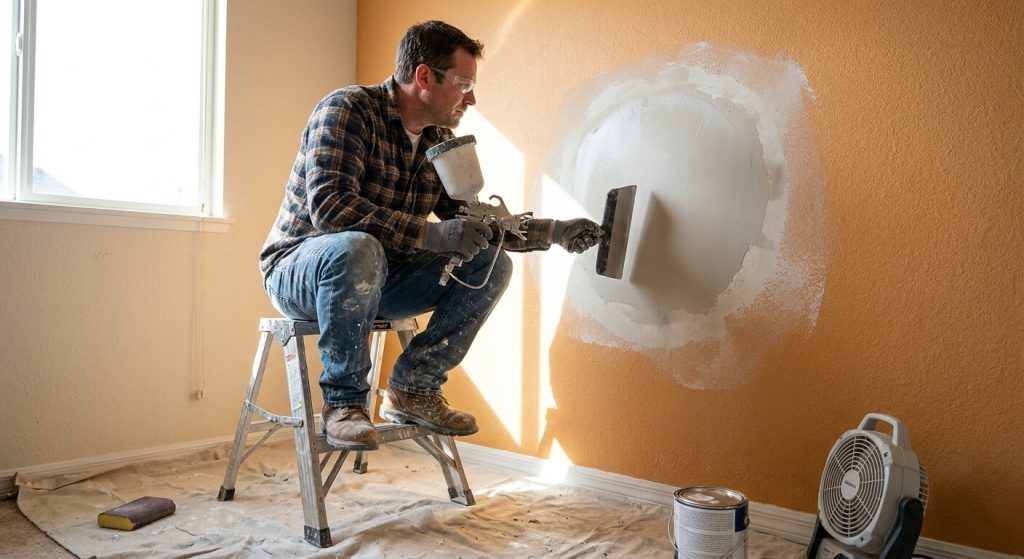
Matching existing texture costs 15 to 25% more than flat drywall because the finisher has to replicate a pattern, not just smooth a surface. A cheap patch on an orange-peel wall will show up immediately as a flat, shiny spot. Knockdown and skip-trowel textures require hand tools and experience to mimic correctly.
If your walls have texture, ask the contractor how they plan to match it. Vague answers mean visible patches.
Ceiling and High-Access Work
Ceiling repairs carry a 20 to 30% labor premium. The finisher works overhead, which is physically demanding and slower. Safety equipment, scaffolding, or tall ladders add setup time. A small hole on a 10-foot ceiling is objectively harder than the same hole on a wall at chest height.
The premium is justified. Ceiling repairs done poorly are more visible because ceilings catch light at low angles all day.
Water Damage and Pre-Treatment Costs
Water-stained or previously wet drywall may need mold inspection, stain-blocking primers like BIN or Kilz, or expanded cuts to remove all compromised material. These steps add $50 to $150 but prevent recurring problems. A contractor who skips them to keep the bid low is setting you up for stains that reappear after the first humid day.
Regional Variations: Why Your Quote May Differ
Southern California metro areas (including parts of Kern County and surrounding regions) have higher labor and material costs than rural areas or low-cost-of-living states. A repair quoted at $75 per square foot in Bakersfield might be $50 per square foot in rural Texas, but the quality and process should be identical.
Wage rates, fuel costs, supply-chain logistics, and local demand all influence pricing. Contractors in high-cost regions aren’t overcharging. They’re covering real expenses to operate legally and sustainably. If you see a quote significantly below local norms, the contractor is either cutting corners, uninsured, or inexperienced.
Repair vs. Replacement: When to Stop Patching
Sometimes patching costs more than replacing a full sheet. Use this decision guide:
- Patch if: damage is localized, less than 4 square feet, and walls are textured or painted a custom color that’s hard to match across a seam.
- Replace the sheet if: damage covers more than half the drywall panel, multiple holes cluster in one area, or the existing drywall is old, soft, or water-damaged throughout.
- Replace if: you’re repainting the entire room anyway, making seam visibility irrelevant.
- Patch if: you’re preparing to sell and need invisible touch-ups without a full remodel budget.
Honest contractors will tell you when replacement is more economical, even if it means they do less finish work. That transparency signals a shop you can trust.
Red Flags: When a Quote Is Too Cheap
A suspiciously low quote often hides problems you’ll discover after payment. Watch for these warning signs:
- No texture matching or paint touch-up included. The patch will be obvious, and you’ll pay someone else to redo it.
- Vague scope. “We’ll patch it” without specifying coats, sanding, priming, or blending means the contractor plans to do the minimum and leave.
- Pressure to pay cash upfront. Legitimate contractors accept checks, cards, or invoicing and don’t demand full payment before starting.
- No license or insurance verification. If they won’t provide a license number or proof of liability coverage, walk away.
Precision Patch Pros operates with transparent pricing, a 5-year guarantee, and upfront scope clarity. That’s the standard. Anything less is a gamble.
Money-Saving Tips Without Sacrificing Quality
- Batch multiple repairs into one visit. Contractors spread travel and setup costs across all repairs, lowering the per-job overhead. A $175 patch becomes $140 each when you schedule three at once.
- Provide clear photos upfront. Text 2 to 3 well-lit images showing the damage, surrounding texture, and overall wall. Accurate quotes happen faster, and you avoid surprise costs when the contractor arrives.
- Schedule during off-peak times. Some shops offer modest discounts for mid-week or mid-month appointments when demand is lower. Ask if flexibility saves you money.
How to Get an Accurate Quote
The fastest way to get a reliable quote is to send clear photos. Here’s what to capture:
- Wide shot showing the damaged area in context (whole wall or ceiling section).
- Close-up of the damage itself so the contractor can gauge depth, size, and material condition.
- Texture detail so they can plan matching strategy.
In your message, mention whether it’s a wall or ceiling, whether there’s water damage or staining, and what texture type you think you have (smooth, orange peel, knockdown, popcorn). Upfront clarity prevents surprises. Many reputable contractors (like Precision Patch Pros) can return a quote within 10 minutes of receiving photos, because they’ve systematized estimating and know their pricing inside out.
If a contractor insists on an in-person visit before quoting a straightforward patch, they either lack confidence in their pricing or plan to upsell once they’re in your home. Both are red flags.
Summary: Fair Pricing for Invisible Results
In Southern California in 2026, expect to pay $75 to $95 per square foot for quality, texture-matched drywall repair, or $150 to $300 for a small to medium patch when you factor in minimums and finish work. That range reflects real labor skill, proper materials, and a guarantee that the repair will disappear.
The cheapest quote isn’t the best value. It’s often the most expensive in the long run because you’ll pay twice: once for the botched job, once for the fix. Invisible results come from contractors who price their skill appropriately, use proven systems, and stand behind their work for years. When you understand what you’re paying for, the decision becomes simple. You’re not buying drywall. You’re buying peace of mind that the damage never happened.
Ready to get a fast, transparent quote for your repair? Text us 2-3 photos and get an estimate in 10 minutes. We’ll tell you exactly what it will cost and exactly what you’ll get: a repair that disappears, guaranteed for 5 years.
Frequently Asked Questions
How much does drywall repair cost per square foot in 2026?
Quality drywall repair in Southern California typically costs $75 to $95 per square foot, including labor, materials, texture matching, and finish work. Simpler repairs in lower-cost regions may run $50 to $75 per square foot. Extremely low quotes often exclude texture blending or proper feathering, resulting in visible patches.
What is the average labor cost for drywall repair?
Labor usually represents 75 to 85% of the total repair cost. Expect $60 to $100 per hour, or $150 to $250 in labor for a typical medium-sized patch. Skilled finishers command higher rates because texture matching, feathering, and blending are specialized skills that require years of practice.
Is drywall repair priced by the hour or by the square foot?
Reputable contractors often price by the square foot because it offers predictability for both parties and rewards efficiency. Hourly pricing is less common for routine patches and can lead to unpredictable final costs. Flat minimums of $150 to $250 cover small jobs regardless of size.
How much more does textured drywall repair cost?
Texture matching adds 15 to 25% to the labor cost because it requires spray equipment, hand tools, or specialty techniques to replicate orange peel, knockdown, or skip-trowel patterns. Smooth walls are the least expensive to patch invisibly.
What is the minimum charge for a drywall patch?
Most established contractors charge a minimum of $150 to $250 to cover travel, setup, and overhead, even for very small repairs. This is standard practice and ensures that small jobs remain profitable and receive the same quality attention as larger projects.
How much does ceiling drywall repair cost per square foot?
Ceiling repairs typically cost 20 to 30% more than wall repairs due to overhead labor difficulty, scaffolding or ladder setup, and safety considerations. Expect to add $50 to $150 to the base repair quote for ceiling work.
What affects drywall repair cost besides hole size?
Texture complexity, ceiling versus wall location, water damage requiring stain treatment, travel distance, and finish quality expectations all influence final cost. Rush scheduling and same-day service also add premiums.
When does drywall repair become more expensive than replacing a full sheet?
If damage exceeds 4 square feet, clusters across multiple areas, or the existing drywall is old and soft, full sheet replacement often costs less than extensive patching. Contractors should recommend replacement honestly when it’s the more economical option, even if it means less finish labor.