
Drywall repair in California City means fixing the gypsum board you already have: filling holes, retaping cracks, cutting out water-stained ceiling sections, rebuilding the texture, then blending paint so the spot disappears. In the East Kern high desert, the job comes with a few local wrinkles. Dry air and wide temperature swings keep walls moving, trades leave access cuts behind after every plumbing or electrical call, and contractors often drive in from larger Kern County and Antelope Valley markets, which shapes what you pay.
Here’s what the work involves locally, what it typically runs, when a permit enters the picture, and how to check out a provider before you book.
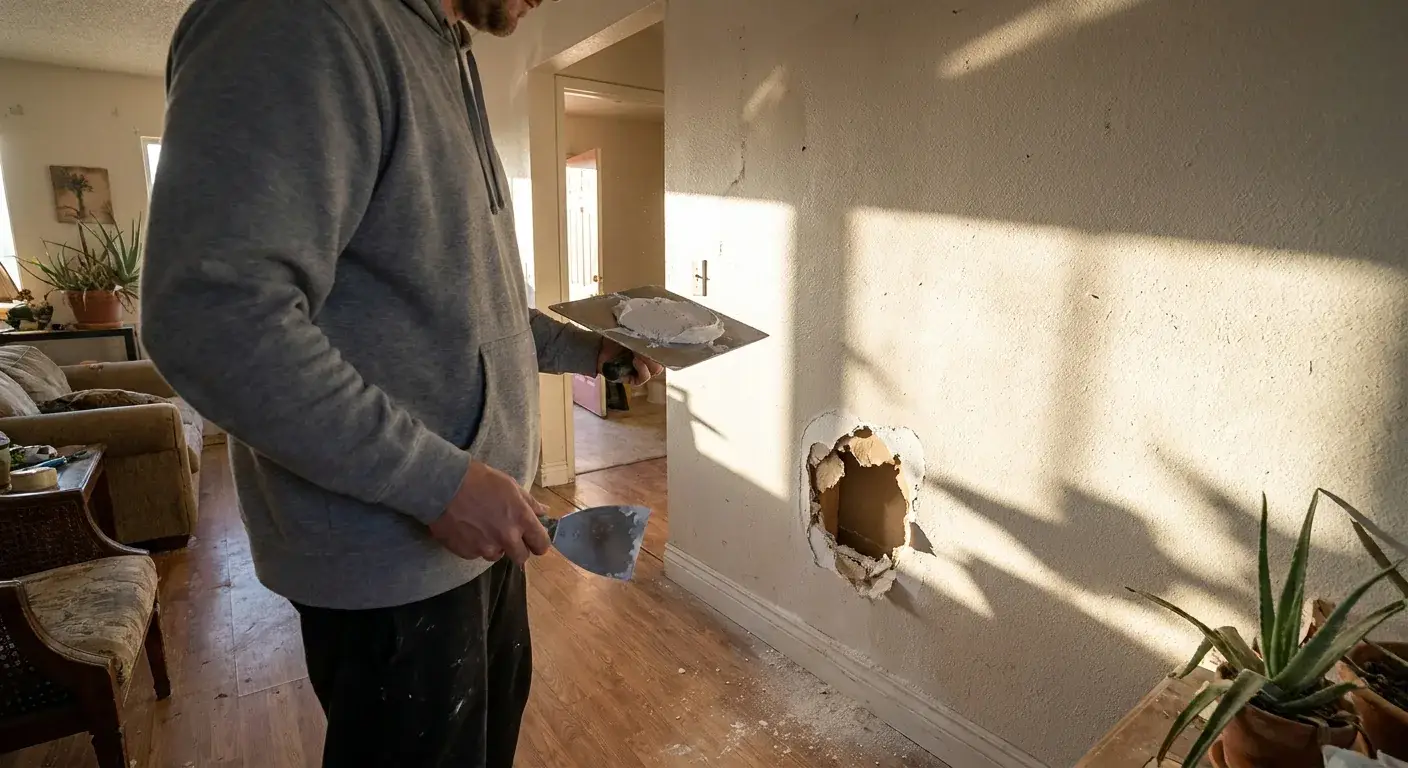
What drywall repair looks like in California City
Drywall repair is cosmetic surgery on a wall or ceiling. A pro cuts back the damage to solid edges, adds backing if the hole spans a cavity, tapes and mudds the joint in two or three coats, sands it flat, sprays or hand-applies texture to match what’s already there, then primes and touches up paint. What tends to work best depends on the damage. A nail pop needs a screw and two coats. A fist-sized hole needs a backed patch. A soft or stained ceiling section needs the bad board removed entirely.
The California patch shows up constantly on small and medium holes. You cut a piece of drywall slightly larger than the hole, snap off the gypsum core around the edges while leaving the paper facing intact, and use that paper flange as built-in tape. No separate joint tape, fewer high spots, faster feathering.
Local homes tend to produce a predictable set of damage:
- Doorknob punches and anchor blowouts from TV mounts, shelves and curtain rods
- Access cut-outs left open after a water heater, slab leak or panel job
- Corner and seam cracking where framing shrinks and moves with the dry desert air and big day-to-night temperature swings
- Water-stained or sagging ceilings from roof leaks, evaporative cooler lines and upstairs plumbing
- Popcorn or heavy texture in older housing stock that no handyman patch ever seems to match
- Move-out damage in rentals, where the whole point is passing a walkthrough on a deadline
Texture matching is the part most repairs fail on. Orange peel, knockdown and smooth all read differently under desert sunlight coming through a west window. A patch that looks fine at 9 a.m. can stand out by 5 p.m. That’s the difference between a filled hole and a finished wall, and it’s worth pausing on.
What drywall repair typically costs locally
Most single drywall repairs in this area land somewhere between roughly $120 and $700. The size of the hole is rarely the reason for the spread. The real drivers are the minimum service charge, the drive out, whether texture has to be matched, and whether the quote stops at paint-ready or includes touch-up paint. At Precision Patch Pros, drywall repair in Southern California runs $75 to $95 per square foot with a minimum service charge of $150 to $250, which is why a two-inch hole and a ten-inch hole often cost about the same.
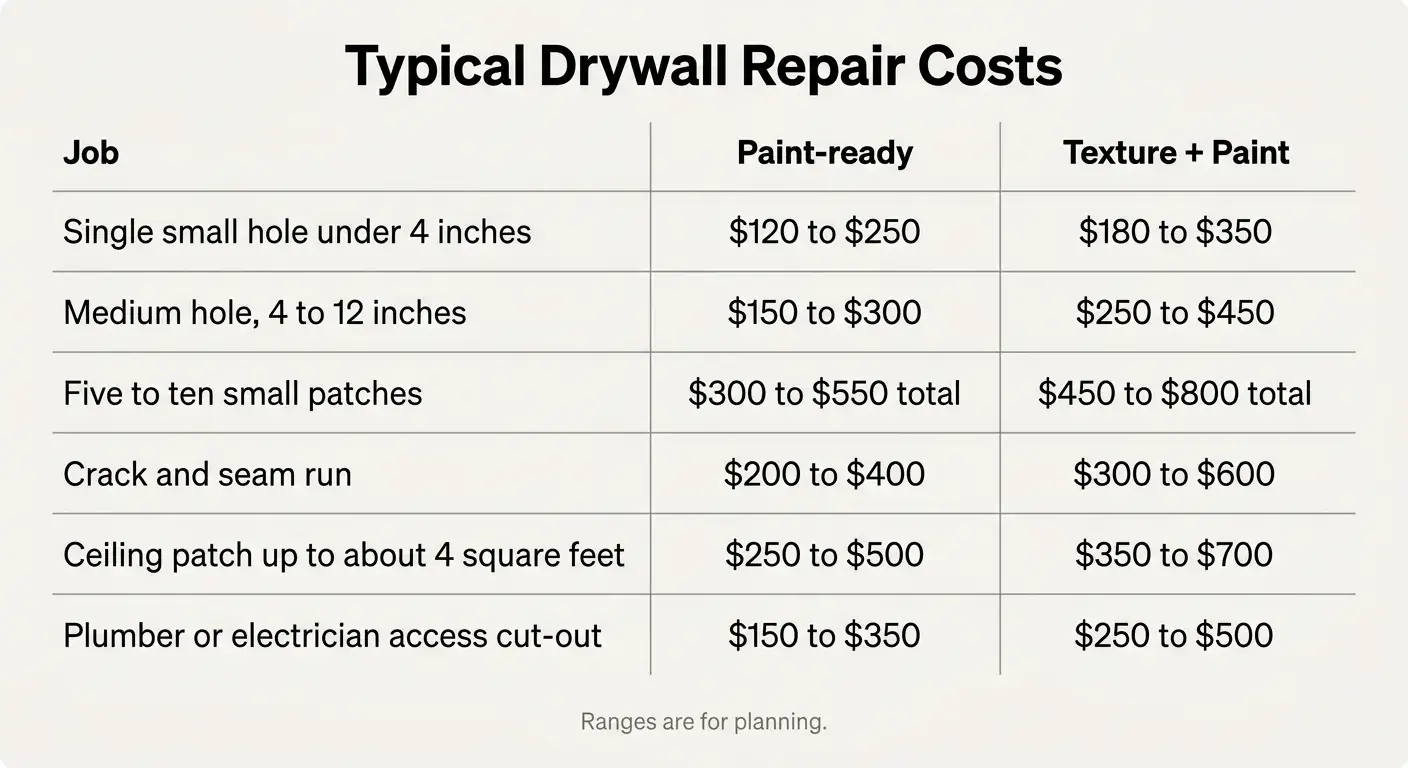
The table below shows typical local ranges for common jobs, side by side: paint-ready versus finished.
| Job | Paint-ready (drywall only) | Texture matched plus paint touch-up |
|---|---|---|
| Single small hole under 4 inches (doorknob, anchor) | $120 to $250 | $180 to $350 |
| Medium hole, 4 to 12 inches (TV mount, impact) | $150 to $300 | $250 to $450 |
| Five to ten small patches, one visit | $300 to $550 total | $450 to $800 total |
| Crack and seam run along one wall or ceiling line | $200 to $400 | $300 to $600 |
| Ceiling patch up to about 4 square feet | $250 to $500 | $350 to $700 |
| Plumber or electrician access cut-out | $150 to $350 | $250 to $500 |
Ranges are for planning, not quotes. A company blog puts most doorknob and punch hole repairs between $80 and $250.
Three things explain almost every surprise on a drywall invoice:
- The minimum call. Materials for one small patch cost a few dollars. The trip, setup, masking, cleanup and return for a second mud coat cost real money, so nobody prices a lone hole at cost.
- Travel into the high desert. Providers covering East Kern and the Victor Valley absorb long drives. That shows up either as a higher minimum or a trip fee, and it’s fair to ask which.
- Paint scope. Texture and paint commonly add $60 to $200 per patch in labor and can double the time on a large blend. Stopping at paint-ready saves money only if you already have the exact paint and are comfortable rolling the wall yourself.
Ceilings run higher than walls for the same square footage because of ladder work, overhead mudding, and sanding with everything below it masked off. Water damage adds demo and haul-away.
Bundling is the one lever homeowners control. Ten scattered small patches booked as ten service calls is the most expensive way to buy drywall repair. The same ten patches on one visit spread the minimum and the drive across all of them, often landing under $80 per patch.
When drywall repair may need a permit
For ordinary cosmetic patching, you generally don’t need a permit. According to California City Building Department, the Building and Safety Division enforces the California Building Codes along with related federal, state and city adopted laws and ordinances, so the local department is the authority on where your job falls.
The answer changes when the work stops being cosmetic:
- Larger removal and replacement. Once you’re taking out and replacing drywall rather than patching it, inspection under a permit can apply. According to City of Solana Beach Building Services, some projects involving drywall removal and replacement require inspection under a permit.
- Fire-rated assemblies. Garage-to-house separation walls and ceilings, shared walls in duplexes and certain ceiling assemblies are rated. These typically call for reinforced gypsum board rather than standard half-inch drywall.
- Work tied to another trade. If the wall is open because wiring, plumbing, insulation or a window is being changed, the permit follows that work, not the patch.
- Water or fire damage. Any repair that reaches framing, insulation or structural members is a different scope from a surface patch.
A practical rule: if the repair is smaller than a sheet, on a non-rated interior wall, and nothing behind it is being altered, it’s almost always ordinary repair. If it involves a garage separation, a ceiling assembly, or anything a permit already covers, call the building department before work starts. Penalties for unpermitted work aren’t worth the guesswork.
How a drywall repair job usually goes
Small to medium repairs are typically done in one visit. A single patch usually takes one to three hours including texture and touch-up. A larger scope, say a ceiling section or five to ten patches across a house, runs most of a day. Water damage is the exception, since the area has to be dry before anything gets closed up.
The sequence rarely changes:
- Photo quote. Send two or three pictures with your ZIP code. Precision Patch Pros replies with a quote within 10 minutes.
- Protection. Floors and furniture get covered before a knife touches the wall.
- Cut and back. Damaged board comes out to solid edges, and backing goes in where there’s nothing behind the hole.
- Tape and mud. Two or three coats, each feathered wider than the last, with drying time between.
- Sand and texture. Sanded flat, then matched to the surrounding orange peel, knockdown, smooth or popcorn.
- Prime and touch up. Primer on fresh mud, then paint blended into the wall.
- Cleanup. Dust contained and hauled out, not left for you.
In one recent job, a new window opening got the same treatment. The rough opening patched, corner bead installed, floated smooth, then texture-matched so the repair blended into the wall. That’s the standard to hold a provider to. Not a filled hole, a finished wall.
If you want a number before you plan your week, send two or three pictures and get a quote in 10 minutes.
How to hire a drywall repair pro in California City
A handyman can absolutely fix drywall. For one small hole in a flat-painted closet, that’s often the cheapest sensible choice. The gap shows up on texture, ceilings and anything visible in daylight, where matching and blending is a finish skill rather than a task. Desert conditions make that harder here, since ongoing framing movement and settling mean cracks tend to return if the seam is only skimmed instead of properly cut, taped and bedded.
Pre-booking checklist
- License and insurance. Ask for the CSLB number and check its status. Precision Patch Pros is licensed and insured under CSLB License #830875.
- Drywall focus. A specialist patches walls and ceilings all day. Ask how many texture matches they did last month.
- Texture capability. Confirm they spray and hand-match orange peel, knockdown, smooth and popcorn.
- Scope in writing. Does the price include tape, sanding, texture, primer, paint touch-up, and cleanup, or does it stop at paint-ready?
- Minimum charge and travel. Get the minimum service charge and any trip fee up front, especially for high desert addresses.
- One visit or two. Multiple visits mean more days with dust and masking in your house.
- Workmanship guarantee. Precision Patch Pros backs its work with a 5-year guarantee.
- Reviews that mention matching. Look for reviewers saying they can’t find the repair, not just that the crew was polite.
- What they won’t do. New drywall installation for construction, structural framing, mold remediation, water extraction and emergency dry-out are not patching services. If your job needs those first, you want the right trade in the right order.
Service area note: coverage runs across Bakersfield, Antelope Valley, Victor Valley, East Kern / High Desert, Barstow, Kern River Valley, Santa Clarita Valley, San Fernando Valley, Verdugo Foothills, Tulare and Porterville.
Walk your house once with a pen, note every hole, crack and stain, then send photos of all of them together. One visit, one minimum, one clean result. Request your photo quote now and get patch, texture match and paint touch-up handled in a single trip.
Frequently Asked Questions
What is a California patch drywall?
It’s a patch that uses the drywall’s own paper facing as tape. You cut a replacement piece about two inches larger than the hole, score and snap off the gypsum core around the perimeter, leave the paper flange attached, then bed that flange in joint compound. It works best on holes up to roughly eight inches and leaves a thinner buildup than a taped butterfly patch.
What is considered minor drywall repair?
Minor repair generally means surface damage on a non-rated interior wall: nail pops, hairline seam cracks, dents, anchor holes and holes small enough to patch without replacing a full sheet. Nothing behind the wall gets altered and no framing is exposed or damaged. Once you’re cutting to studs, replacing board on a garage separation, or opening a wet ceiling, it’s no longer minor.
What is the most effective way to repair drywall?
Cut back to sound material, support the patch with backing or the paper flange, then build the joint in thin coats feathered 8 to 12 inches past the edge. Setting-type compound speeds up the first coats, and lightweight topping compound sands easiest for the final pass. The finish work decides the result, so texture match and prime before any touch-up paint goes on.
How do I apply for a drywall repair permit in California City?
You apply through the city’s Building and Safety Division, which enforces the adopted building codes for interior work. Describe the actual scope, the square footage being replaced, and whether the wall or ceiling is part of a rated assembly. California City states that all structures must meet or exceed the minimum life safety standards of codes, laws and ordinances, so confirm scope before demolition rather than after.
Does drywall repair trigger electrical or insulation permit requirements?
The patch itself doesn’t, but the work behind it can. Moving a receptacle, adding a circuit for a TV mount, or replacing insulation in an opened wall are permitted activities in their own right, and the drywall closing them up gets inspected as part of that job. If a trade opened the wall, ask them whether their permit is still open before the patch goes in.
What are the main causes of drywall cracks in California City homes?
Movement, almost always. Wide daily temperature swings, very low humidity, and expansive soil behavior keep framing shrinking and shifting, which shows up first at corner bead, window and door corners, and long ceiling seams. Cracks that reopen in the same line after being filled usually need the seam cut out, retaped and rebedded rather than skimmed again.
Do you repair water-damaged drywall, or does something else need to happen first?
Water-damaged drywall repair is offered, but the area has to be dry and the leak fixed first. Water extraction, emergency dry-out, leak detection and mold remediation are not part of the service, so those come from a restoration or plumbing company ahead of the patch. Once the cavity is dry, the stained board is cut out, replaced, textured and painted to match.
Can landlords bundle move-out drywall repairs into one visit?
Yes, and it’s the smartest way to buy turnover work. Photograph every patch in the unit, send them together, and the whole list gets scheduled as one job instead of separate service calls, which spreads the minimum charge across all the repairs. Most jobs finish in one visit including patch, texture match and paint touch-up, which matters when a deposit deadline or a new tenant date is fixed.