
A doorknob punched through drywall is one of the most common damage calls in the high desert. The hole itself takes twenty minutes. Making it disappear under texture and paint? That’s what separates a clean repair from a patch you can spot from the hallway. This guide covers real price ranges, who to call, whether a hole in the door slab can be saved, and how long the whole thing actually takes.
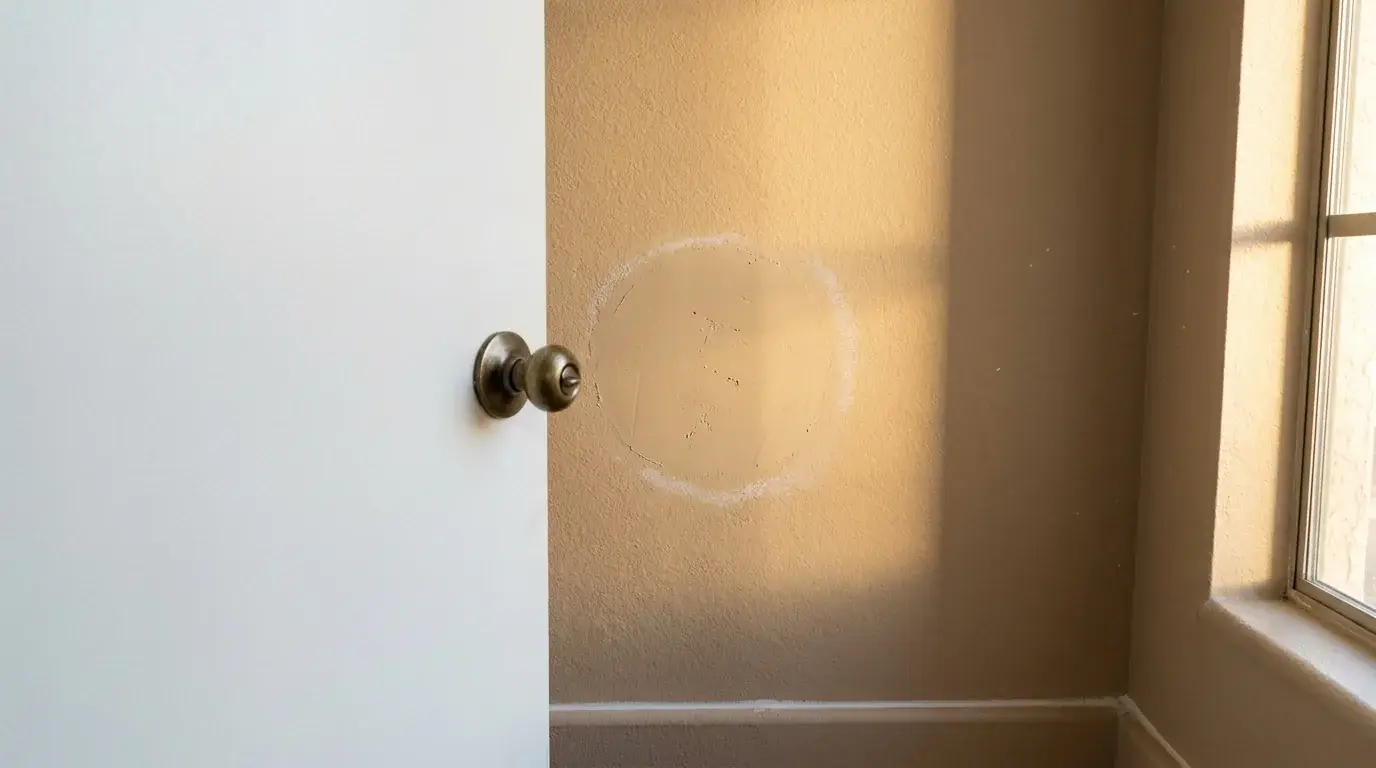
How much does it cost to repair a doorknob hole in drywall in Barstow, CA?
Expect roughly $120 to $250 for a single doorknob hole in a Barstow home, patched, textured, and touched up with paint. At Precision Patch Pros, most doorknob and punch hole repairs run between $80 and $250. The low end is for small, smooth-wall damage. The high end covers larger impacts that need backing and a sprayed texture match.
Here’s how the tiers usually break down locally:
| Damage | Typical size | Typical price range |
|---|---|---|
| Small knob dent or puncture | Under 4 inches | $80 to $175 per patch |
| Standard doorknob blowout | 4 to 12 inches | $150 to $250 per patch |
| Large impact or multiple broken sections | Over 12 inches or crossing a stud | Quoted per job |
Handyman rates in the area often start around $170 for a small hole and patch, plus a service call minimum. A specialist quote usually includes the texture and paint step in the same number. That’s where the two approaches stop being comparable.
What changes the price on a single patch?
Three things move the number: whether the hole needs backing, what texture is on the wall, and whether paint touch-up is included. A knob-sized hole has no drywall behind it, so a proper repair gets a backer or a cut-in drywall plug. Stick-on mesh patches flex and crack later.
A simple patch stops being simple when:
- The hole sits at a corner bead, an outlet, or within a few inches of a door casing
- The wall is plaster or a textured ceiling instead of standard drywall
- The impact cracked the paper across a wide area, so the cut-back has to grow
- The paint is a deep color or a flat sheen that will flash unless the whole wall gets rolled
That last one surprises people. The patch may be invisible while the texture is wet and still show as a dull halo after paint if the sheen doesn’t match.
When do multiple holes lower the per-patch cost?
Because most of the cost is the trip, not the mud. Local minimums commonly land in the $60 to $100 range before any work starts, so the first hole always carries the heaviest share of overhead.
A realistic Barstow example: one doorknob hole might quote at $175. Three holes in the same house, patched on one visit with the same texture and the same paint, often land closer to $325 to $425 total. That works out to roughly $110 to $140 each. Landlords and property managers get the biggest benefit here. Walking the unit once and listing every hole, dent, anchor scar, and TV mount hole before booking is worth more than any coupon.
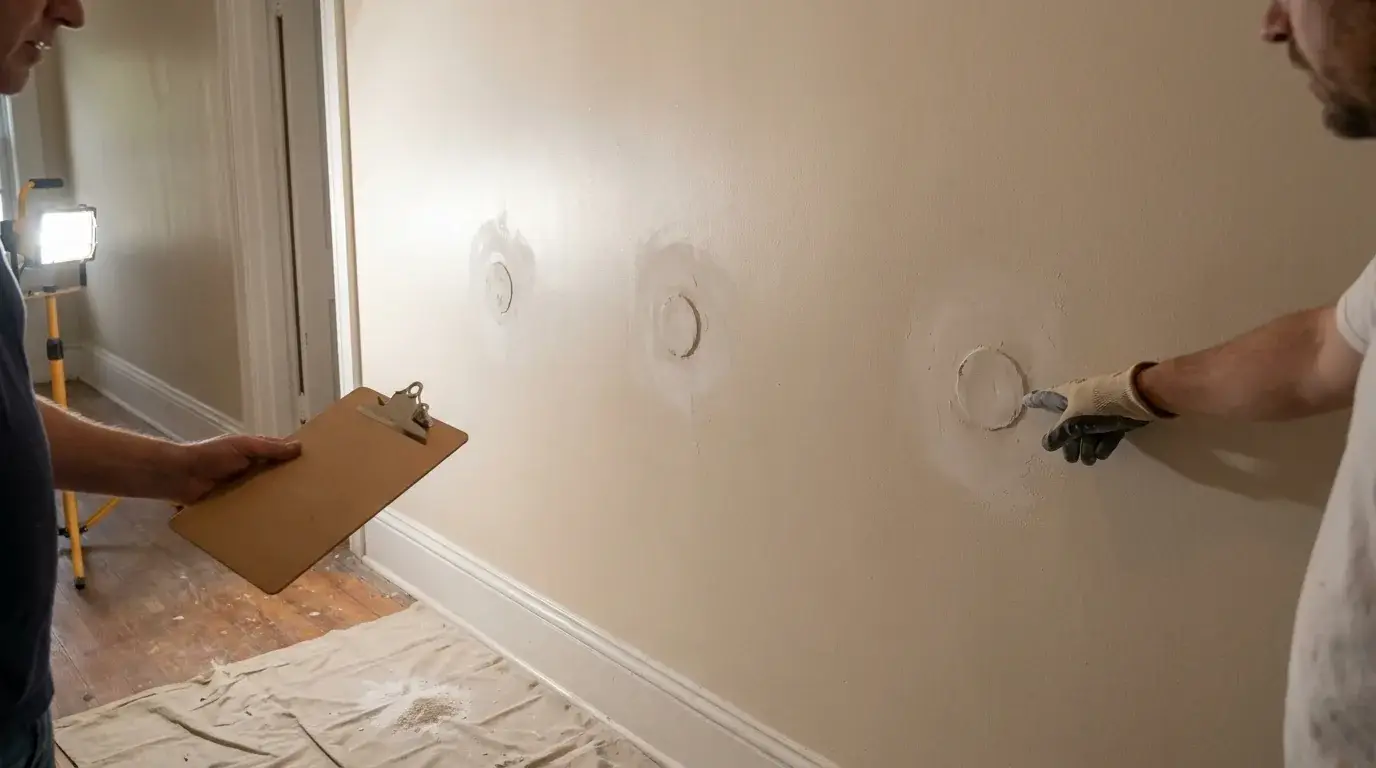
Who fixes doorknob holes in walls in Barstow, a drywall contractor, handyman, or door repair specialist?
Match the trade to the damage. If the drywall is the only casualty, a drywall repair specialist gives you the best finish for the money. If the door, jamb, or lock is involved, you need a second skill set.
- Drywall repair specialist: wall and ceiling holes, cracks, popped nails, damaged seams, texture matching, and paint prep. Best when the repair has to disappear for a sale, an inspection, or a move-out walkthrough.
- General handyman: good value when the wall hole is one of five unrelated tasks and the wall is smooth or lightly textured. Texture matching is where results vary the most.
- Door repair specialist or carpenter: split jambs, sagging hinges, doors that no longer latch, and damage to the slab itself.
- Locksmith: knob, latch, deadbolt, and keypad hardware. They restore function and security, not the wall behind it.
Whoever you call, check the license. Precision Patch Pros is licensed and insured under CSLB License #830875 and has served Southern California since 2020. That matters more than usual when the repair is going into a landlord file or an insurance claim.
Can a punch hole in a door be patched or does the door need replacing?
A hollow-core door can be patched, and it works well as long as the skin is punctured rather than shredded. The standard fix is to clean the broken edges, push in a light backer, fill the cavity with low-expansion foam, trim it flush once cured, then skim with filler, sand, prime, and paint. Budget two to three hours of labor plus dry time, or roughly $120 to $250 on most interior doors.
Replacement wins when any of these are true:
- The latch stile is split or the bore hole has blown out the edge of the door
- The face skin has delaminated or bowed around the impact
- There are several holes in the same slab
- The door is already out of square and drags
A plain hollow-core slab is inexpensive enough that repair savings shrink fast. A replacement still needs boring, hinge mortising, and hanging, so ask for both numbers before choosing. When the knob bore itself is too large or mis-drilled, a door repair plate wraps the latch edge and re-centers the hardware for a fraction of a new door.
Commercial doors follow different rules. When exit doors are installed in pairs and automatic flush bolts are used, the leaf with those bolts must have no door knob or surface-mounted hardware. California Code of Regulations, Title 8, Section 3235 states that rule. California also requires panic hardware to release the door latch when a force not exceeding 15 pounds is applied to the releasing device. If the damaged door is part of an exit path in an office or shop, get the hardware checked, not just the hole filled.
How do Barstow drywall pros match orange peel or knockdown texture when repairing a doorknob hole?
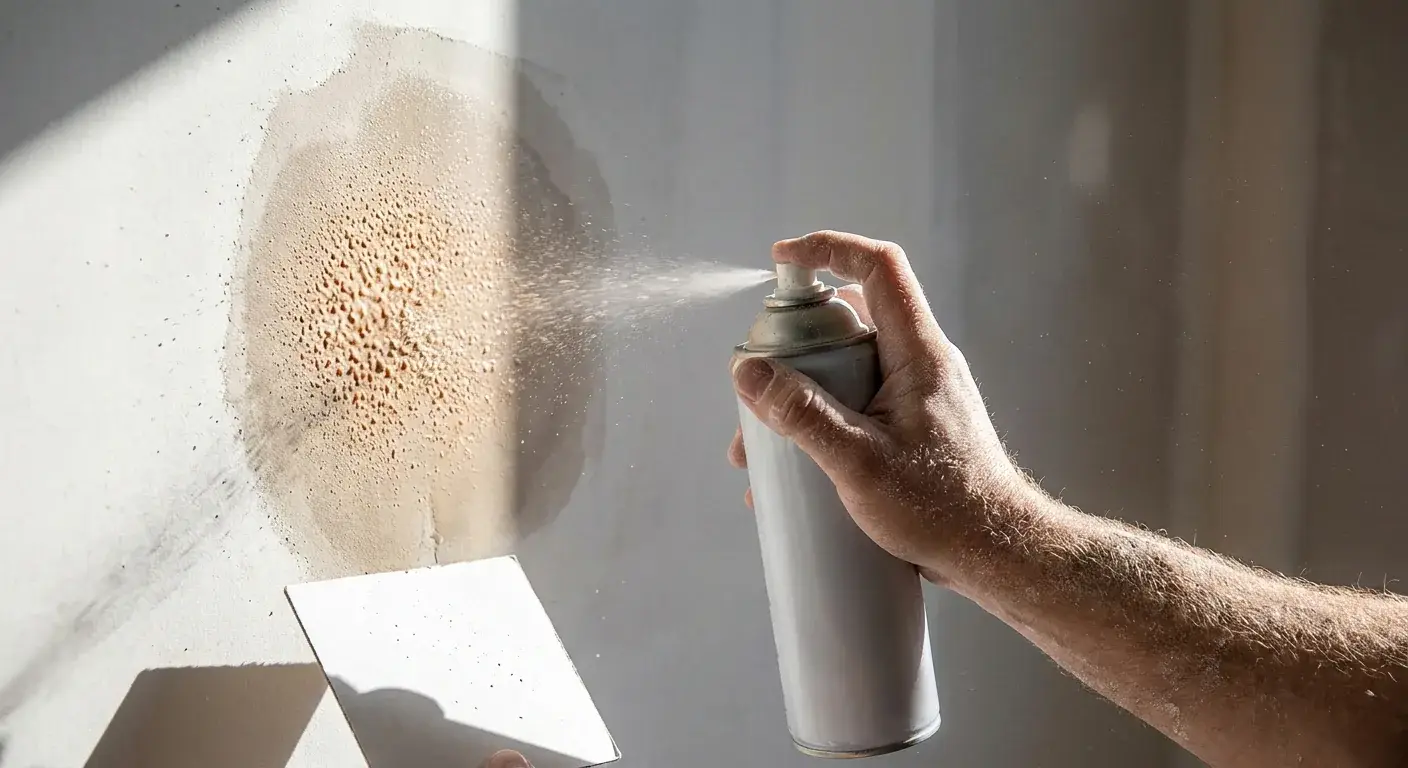
Texture matching is done by spraying thinned joint compound through a hopper or an aerosol can, dialing in the droplet size on a test board, then knocking it down or leaving it raised to copy the surrounding wall. The mud, the air pressure, the nozzle distance, and the timing on the knockdown blade all change the pattern. That’s why two pros can use the same material and get different results.
Difficulty, roughly in order:
- Smooth walls: easiest to fill, hardest to hide. Any hump or sanding scratch reads in side light, so the patch has to be feathered 10 to 12 inches wide.
- Orange peel: the most common finish in desert tract homes and the most forgiving. Fine spray, no knockdown, blends quickly.
- Knockdown: matchable, but the flattened plates have to be the same size as the originals. Timing is everything.
- Popcorn ceilings: the trickiest of the group. Aggregate size and age-yellowed paint often mean the surrounding area needs a blend coat.
Honest contractors will tell you when a repair lands at 90 percent instead of perfect, usually on heavy hand-troweled or skip-trowel patterns. A specialist chases the last 10 percent with a second pass and a feathered paint blend. That extra effort is what a 5-year workmanship guarantee is actually covering.
Pro-tip: photo quote and texture-match checklist – Shoot one wide photo of the wall and one close-up from about 12 inches away – Take a second close-up with a lamp held to the side so the texture casts shadows – Include a ruler, a phone, or a credit card in frame for scale – Note the paint sheen and whether you still have the original can – Send your zip code with the photos
At Precision Patch Pros, you send a couple of pictures and your zip code, and a quote comes back within 10 minutes. That’s the fastest way to get a real number for your doorknob hole without booking an in-person estimate.
Is it cheaper to DIY a doorknob hole repair in Barstow than to hire a pro?
On materials alone, yes. On finished result, usually no. The gap widens the moment texture and paint enter the picture.
| DIY | Professional | |
|---|---|---|
| Materials | $55 to $95 (patch, compound, texture can, primer, sample paint, sanding sponge) | Included |
| Your time | 3 to 4 hours spread over 2 days | None |
| Tools you may still buy | Taping knives, hawk or pan, sanding pole | Included |
| Texture match | Trial and error on one can | Test board, adjusted spray, feathered blend |
| Risk | Flashing, visible hump, mismatched pattern | Backed by a 5-year workmanship guarantee |
The math only works if you already own knives and you’re patching a smooth or lightly textured wall in a low-light hallway. The common failures are predictable. Lightweight all-in-one spackle shrinks and leaves a dimple. Adhesive mesh patches telegraph a square outline after a season of temperature swings. A rattle-can texture sprayed too close leaves coarse blobs that no amount of paint hides.
The real cost shows up later. A buyer’s inspector, a property manager at a move-out walkthrough, or an appraiser walking a hallway will flag an obvious patch. A deposit deduction or a repair credit usually costs more than the original quote would have.
How long will a typical doorknob wall repair take from first call to “can’t see it anymore,” including dry time, texture, and paint?
Plan on same-week service and one visit of roughly one to three hours for a single hole. Precision Patch Pros completes most jobs in one visit, including patch, texture match, and paint touch-up. Setting-type compound cures on a clock rather than by evaporation.
A realistic schedule looks like this:
- Minute 0 to 10: photo quote comes back
- Day 1 or 2: appointment, floors and furniture covered
- First 30 minutes: cut back damage, install backing, set the plug, tape and first coat
- Next 60 to 90 minutes: second and third coats between set times, sand flush, spray texture
- Final 30 minutes: prime the patch, touch up paint, clean up
Setting-type compounds sold as 20, 45, or 90 minute mud harden chemically on that schedule. Premixed all-purpose compound generally needs about a day per coat before sanding.
Two situations add a return trip: a deep-color or high-sheen wall that needs a full wall rolled after the patch cures, and heavy popcorn or hand-trowel textures that need overnight cure before the finish coat. Five patches across one house still usually fit in a single half-day visit, since the crew is cycling coats from room to room.
How do I prevent doorknob holes from happening again after the repair?
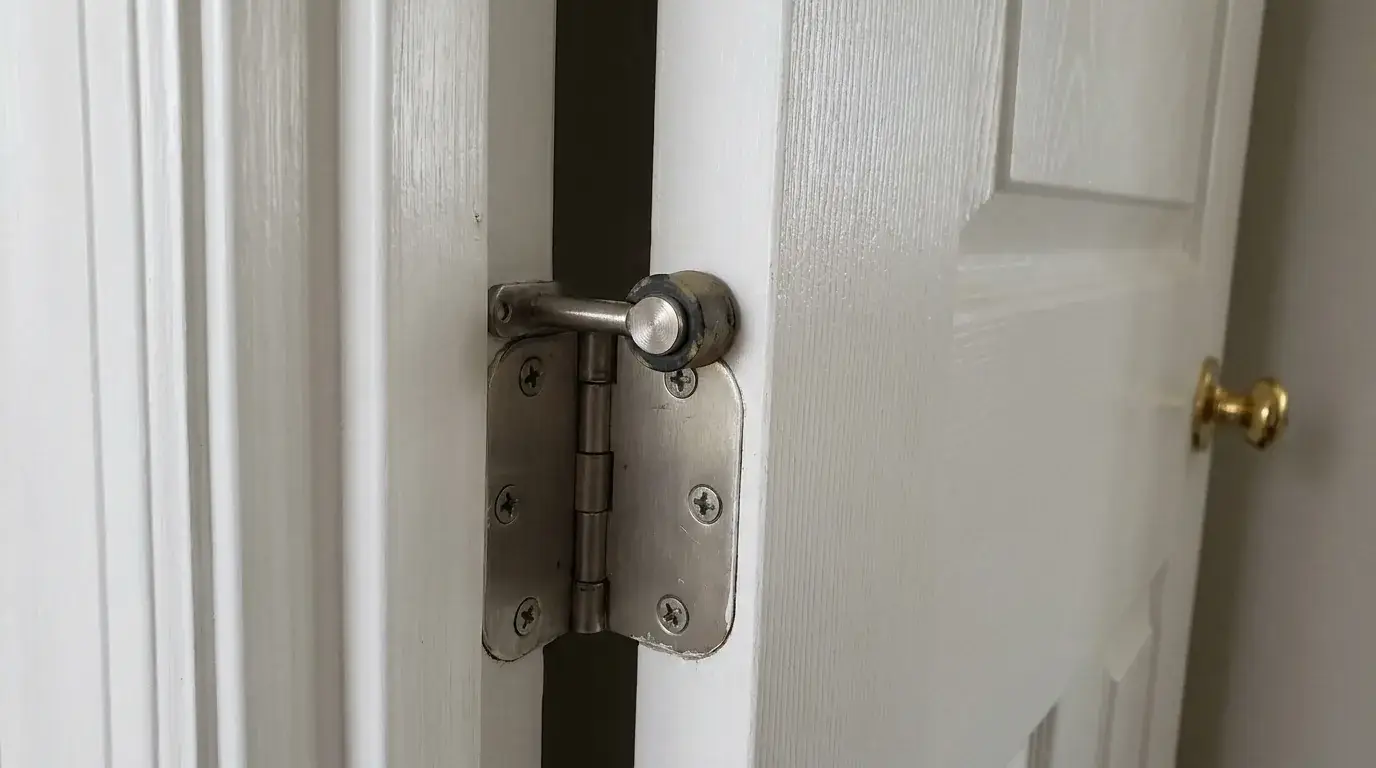
Install a stop that takes the impact before the knob does, and put it where it can’t be kicked loose. The wall guard by itself is the weakest option. It protects the paint and does nothing about the force.
- Hinge-pin stop, $4 to $10. Replaces a hinge pin and catches the door at the top. Best for doors with no baseboard landing spot or thick carpet. Quietest and hardest to knock off.
- Baseboard spring stop, $3 to $8. Cheap and universal, but the tip pops off and the spring bends. Fine for low-traffic bedrooms.
- Rigid floor-mounted stop, $8 to $20. Anchored into the subfloor, stops the door dead. Best for kids’ rooms and rental turnovers, worst for bare feet and vacuums.
- Wall-mounted bumper, $3 to $10 a pair. Must land in a stud or a proper anchor. A bumper set in bare drywall becomes tomorrow’s hole.
- Clear wall shield or guard plate, $5 to $15. Good over a healed patch on a door that swings hard. Mount it at knob height, centered on the arc, not on the visible seam.
About the shortcut people ask about: sticking a round protector over an existing hole is a cover, not a repair. It’s acceptable over shallow dents under about an inch that never broke the paper. Over an actual hole, the drywall edges keep crumbling behind the plate, the adhesive pulls paint when it comes off, and landlords do notice at walkthrough. Patch first, then protect.
Ready to make the damage look like it never happened? Send 2 to 3 pictures and your zip code for a Barstow doorknob and punch hole repair quote, and get a straight number back fast.
Frequently Asked Questions
How much to fix a punched door?
A fist or knob-sized hole in a hollow-core interior door usually runs $120 to $250 including filler, sanding, and paint. Solid-core and paneled doors cost more because the repair has to be shaped and grain-matched. If the latch edge is split, price a new slab before paying for a repair.
Can you fix a hole punched in a door?
Yes, when the damage is limited to the face skin. The cavity gets a backer and low-expansion foam. The foam is trimmed flush once cured. Then two or three thin coats of filler are feathered out at least 6 inches past the break. Skip the backer and the filler sinks into the hollow core and cracks.
Are door knob holes universal?
Close to it on residential doors. Standard residential door preparation usually uses a common bore and backset combination, though the exact sizes vary by hardware.
My door handle hole is too big. What can I do to fix it?
Two fixes work. A door reinforcement or repair plate wraps the edge and re-centers the hardware. That’s the fastest option and costs under $20 in parts. For a cleaner look, glue in a wood plug or dowel, let it cure overnight, then re-bore to 2-1/8 inches with a hole saw and refinish.
How do I fix a door knob hole in a plaster wall?
Plaster needs different handling than drywall. The loose keys around the hole get scraped back to sound plaster. A drywall or lath backer is fastened in. Then setting compound is built in layers rather than one thick fill. Rushing it in one pass is what causes the ring of hairline cracks people see six months later.
Is a hardware store doorknob hole repair kit good enough?
For a puncture under about 3 inches on a smooth wall, a kit can work if you use setting compound over the patch instead of lightweight spackle. On textured walls, the included mud rarely matches the surrounding pattern, and the self-adhesive mesh is the number one cause of a visible square outline after paint.
How much does it cost to repair a kicked-in interior door frame so the door latches again?
Local examples for frame work land around $240. Jobs combining a busted frame with a hole in the door have run near $300 in California. Add a reinforcement strike plate with 3 inch screws into the framing, or the same jamb splits the next time. Wall repair around the casing is quoted separately.
When does a big doorknob hole need framing or a new drywall panel instead of a patch?
Once the opening passes roughly 12 inches or spans more than one stud bay, the fix changes from a patch to a cut-out and panel replacement with wood backing screwed to the studs. That moves the job from one to two hours up to a half day, plus texture and paint. Precision Patch Pros handles repair work like that but doesn’t do new construction, drywall hanging, or full-room installs.
Will my landlord deduct my deposit for a doorknob hole?
Usually, yes. Often at a markup over what a direct repair would have cost. Getting it patched, textured, and painted before the walkthrough is the cheaper path, especially when several small holes can be bundled into one visit. Keep the invoice. Licensed contractor paperwork carries weight in a deposit dispute.